As we celebrate the nation’s 250th anniversary, it is heartening that America’s national symbol, the bald eagle, is no longer imperiled. Although once at risk of extinction throughout much of its historical range, this majestic species rebounded in the late 20th century, and populations are now in good health.
At the time of the nation’s founding, the American bald eagle was quite abundant. There were as many as 100,000 eagles in what would become the United States. While Benjamin Franklin thought the bald eagle was “a bird of bad moral character,” it had long been viewed as a symbol of strength, and it found a place in the Great Seal of the United States adopted by Congress in 1782. (Curiously, Congress did not formally make it the national bird until 2024.) In the 19th century, however, populations declined due to a range of factors, including hunting and habitat loss.
Bald eagles may be considered charismatic megafauna today, but it was not always thus. Indeed, they were once feared as predators. Although bald eagles eat mostly fish and carrion, they are opportunistic feeders that will also take small mammals, other birds, and even turtles—and farmers worried they would prey on poultry and livestock. The bald eagle was viewed more as a pest to eradicate than as a keystone species to conserve. Fortunately that perception of the bald eagle did not persist, and conservation efforts helped populations recover.
The bald eagle’s rebound in the 20th century is unquestionably a great American conservation success story, though there is some debate about what drove its recovery. The U.S. Fish and Wildlife Service refers to the bald eagle as “an Endangered Species Act success story,” yet history suggests otherwise. Not only is the act unlikely to have contributed significantly to the bald eagle’s recovery, but the rebound of the species also offers lessons for making other wildlife conservation efforts more effective.
While some want to credit the Endangered Species Act for preserving our national symbol, federal efforts to protect the bald eagle actually began decades earlier. The Migratory Bird Treaty Act was enacted in 1918, but its effects were limited. Concerned about declining bald eagle populations, Congress enacted the Bald Eagle Protection Act in 1940. Under this law it is illegal to “take, possess, sell, purchase, barter, offer to sell, purchase or barter, transport, export or import, at any time or any manner, any bald eagle … live or dead … ” without a federal permit. The law further defines prohibited “takes” to include efforts to “pursue, shoot, shoot at, poison, wound, kill, capture, trap, collect, molest or disturb” bald eagles, and it further prohibits the possession, purchase or sale of eagle parts, feathers, and eggs. (As later amended, the act protects golden eagles, too.) Permits for incidental takes of bald eagles may only be issued where the secretary of the interior finds such takes to be “compatible with the preservation” of the species.
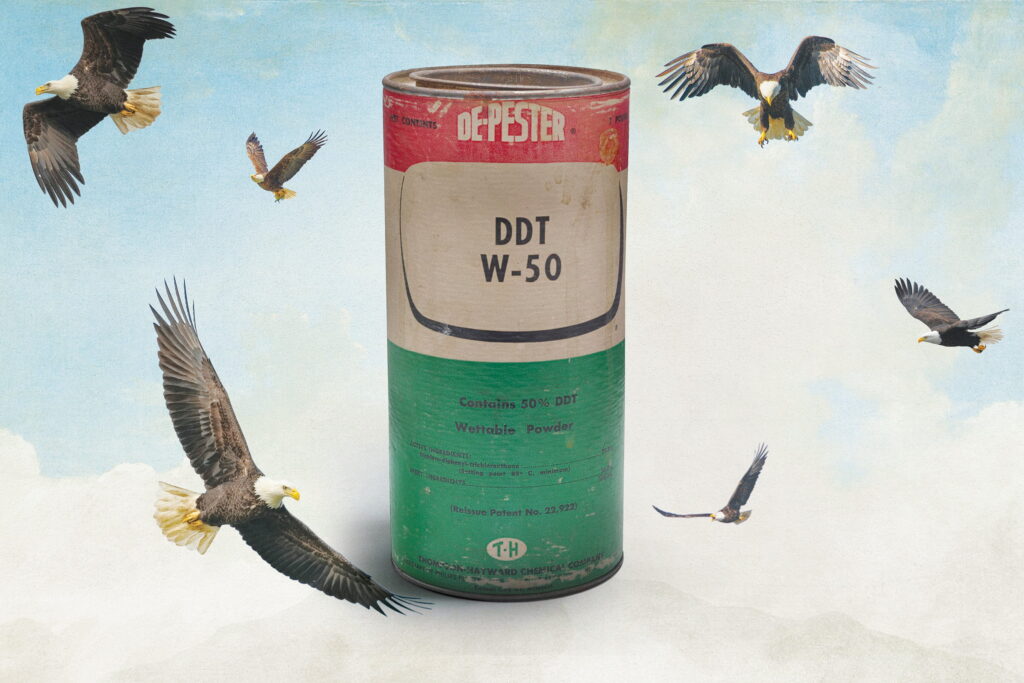
The Bald Eagle Protection Act was an important measure to protect the bird from hunting, but that was hardly the only threat eagles faced. The greatest threat to bald eagle populations in the 20th century came from the widespread—and at times quite reckless—use of the pesticide dichloro-diphenyl-trichloroethane, or DDT. Once hailed as a miraculous pesticide, DDT was sprayed indiscriminately throughout much of the United States after World War II. While effective at controlling insect-borne disease, DDT also bioaccumulated in various raptor species and caused eggshell thinning, threatening their ability to reproduce. This not only threatened eagles but also brown pelicans, peregrine falcons, and other raptor species. DDT’s effects helped inspire Rachel Carson’s influential book, Silent Spring.
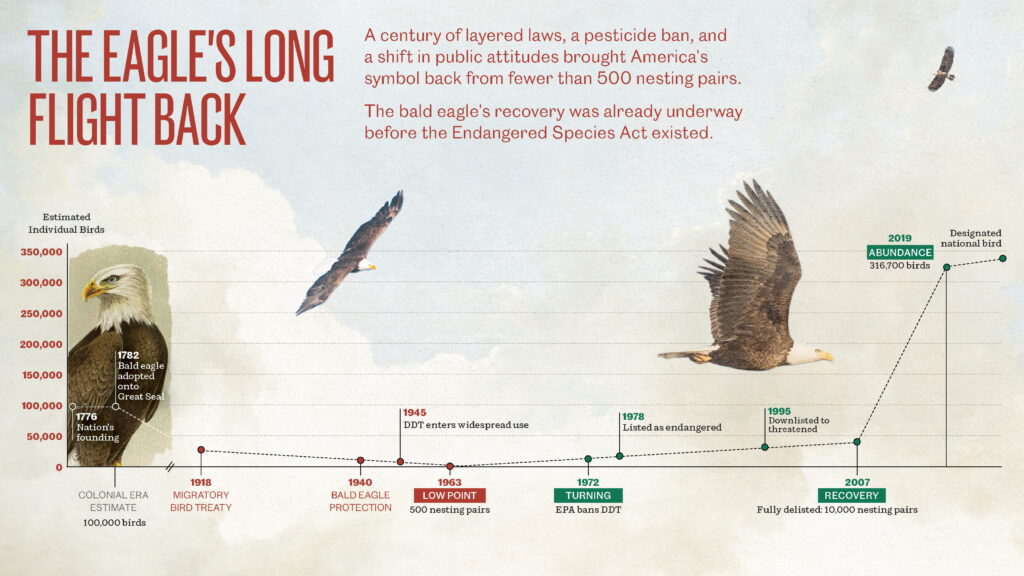
While not the only threat to bald eagles, DDT was a particularly pernicious one, and populations continued to plummet in the aftermath of DDT’s introduction. According to the Fish and Wildlife Service, there were fewer than 500 nesting pairs in 1963—a decline of over 90 percent from estimated colonial-era populations.
As the evidence against DDT accumulated, the Environmental Protection Agency—not the Fish and Wildlife Service—took action, issuing an order in 1972 that largely prohibited DDT spraying in the United States. The Endangered Species Act was not enacted until one year later, in 1973, and most bald eagle populations in the lower 48 states were not listed as endangered until 1978. Not only did the ESA have nothing to do with eliminating the threat to bald eagle populations posed by DDT, it did little to add to the regulatory protection against hunting and poaching that Congress had enacted in 1940.
In 1995, the Fish and Wildlife Service downlisted most bald eagle populations from endangered to threatened. Official recovery came more than a decade later, although not without opposition. Some environmentalist groups fought the removal of the bald eagle from endangered species regulations and took the service to court.
When the Fish and Wildlife Service fully delisted bald eagles in 2007, it estimated there were nearly 10,000 nesting pairs in the lower 48 states—more than 20 times the 1963 figure. Since then, dramatic progress has continued, even without Endangered Species Act “protections.” In 2021, the service estimated that by 2019 the bald eagle population in the lower 48 had reached 316,700 individual birds, including 71,467 breeding pairs, quadrupling since 2009. Bald eagles can now be found in all of the continental United States.
According to the Fish and Wildlife Service, listing bald eagles under the ESA “provided the springboard for the Service and its partners to accelerate the pace of recovery through captive breeding programs, reintroduction efforts, law enforcement, and nest site protection during the breeding season.” It may well be that it was easier to devote resources and focus attention on bald eagle conservation once the bird was listed as endangered, but there is still little evidence that its regulatory protections played a significant role in the bird’s recovery.
There is still little evidence that the ESA’s regulatory protections played a significant role in the bird’s recovery.
The act’s defenders point to the bald eagle as an ESA success story in part because there are so few ESA successes to celebrate. In over 50 years, the act can be credited with, at most, a handful of recoveries, and there is ample evidence that, for some species, the act’s “protections” do more harm than good. When a majority of listed species rely upon private land for habitat, it is not a good idea to penalize owners of habitat. Yet all too often, that is precisely what the act does. A more effective strategy would be to enlist landowners as active conservationists.
The listing of a species as endangered triggers a suite of costly and heavy-handed regulatory measures. And as implemented for most of the act’s history, listing a species as threatened has the same effect. Although the act, as written, allows federal regulators to exercise discretion and adopt flexible, species-specific conservation strategies for threatened species, existing regulations treat most threatened species as if they were endangered, triggering the same inflexible rules for each species listed. Adopting such a one-size-fits-all approach to species conservation is easier to implement, and satisfies those who see the Endangered Species Act as a powerful means to inhibit development, but it does not work for all species. The strategies that work for some species will not work for others, and blunderbuss habitat regulation may not work for many species at all.
Americans should be pleased that bald eagle populations continue to expand. The growing number of bald eagles is a conservation success story. But given the act’s longstanding and widespread record of failing to promote species recovery, we should be careful before attributing that success to the Endangered Species Act.