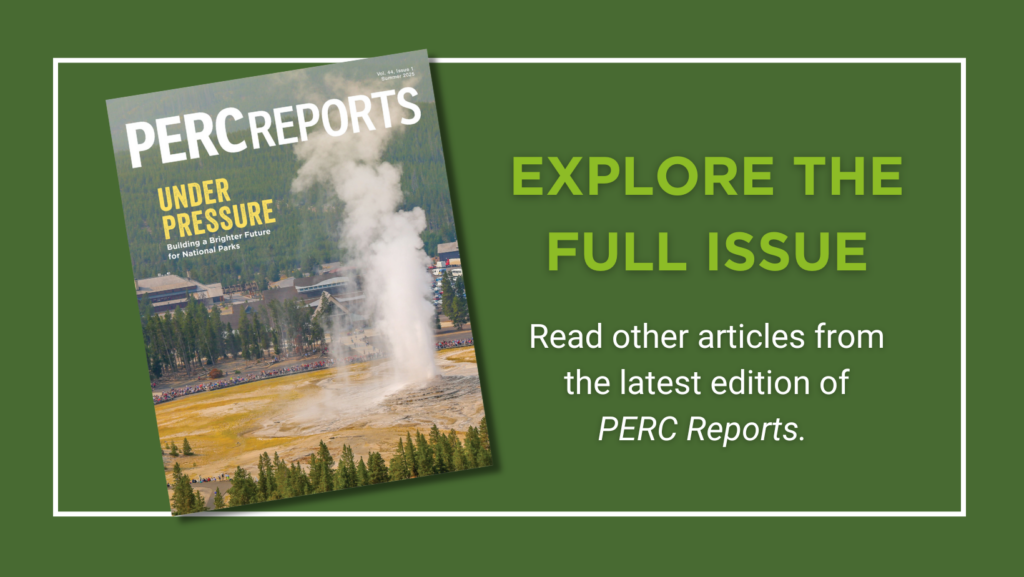

This special issue of PERC Reports explores the next wave of solutions for our national parks.
More than a century after the creation of the National Park Service, Americans’ love for our parks shows no sign of fading. Crowds continue to grow, summers bring record visitation, and parks regularly top bucket lists for travelers from around the world. These treasured landscapes are more popular—and more strained—than ever.
That strain is increasingly visible. Headlines about traffic jams, overflowing trash cans, and deferred maintenance have become as routine as the changing of the seasons. Across the system, roads crumble, water systems fail, and trails fall into disrepair. Meanwhile, staffing levels have declined, squeezed by budget pressures and federal hiring hurdles. Adjusted for inflation, operations funding for the National Park Service has stagnated for years, spanning multiple presidential administrations. All the while, Congress continues to create new parks, often without commensurate resources to manage and maintain them.
The result is a troubling contradiction: Even as public enthusiasm for parks surges, our ability to steward them has struggled to keep pace. Crowds themselves aren’t the problem. After all, hundreds of millions of visitors flocking to national parks each year is a sign that people care deeply about these places. But the high visitation exposes the consequences of broken management models and outdated funding structures—a system that hasn’t evolved to meet modern needs.
Despite these challenges, a path forward is emerging. Solutions demand more than simplistic calls for more money or fewer visitors. Instead, they require smarter management, more flexibility, and a willingness to innovate. Parks need tools, authority, and incentives to solve problems in creative, site-specific ways. And as many parks across the country are already showing, local leadership and thoughtful experimentation can make sure our parks remain unrivaled destinations for generations to come.

Strategies for Stewardship
For decades, the default response to park challenges has been reactive: patch funding shortfalls with occasional boosts in appropriations, paper over growing maintenance needs with temporary programs, and defer strategy-making to Washington, D.C. Yet such approaches are rarely sufficient for the on-the-ground realities of managing such a diverse set of public landscapes.
As PERC has laid out in research spanning several decades—from examining early fee structures in the 1990s, to studying ways to break the backlog at the 2016 centennial, to analyzing the Great American Outdoors Act more recently—the park system is due for structural reforms that modernize management and reorient it toward long-term stewardship. Many of the challenges facing national parks today—whether in infrastructure, visitor management, or staffing—stem from outdated models of funding and operations and misplaced incentives. There’s no one-size-fits-all fix for the challenges facing America’s national parks. But several broad strategies offer ways to think about stewarding these landscapes into the future—strategies grounded in flexibility, sound incentives, respect for local conditions, and clear accountability.
Here are five principles that can help guide national parks toward a more resilient, responsive future.
1. Stop Encouraging Deferred Maintenance
The maintenance backlog across national parks stands at $23 billion, and that figure has continued to grow despite a generational investment from the Legacy Restoration Fund of the Great American Outdoors Act, enacted in 2020. That’s partly because, under current policy, there’s a perverse incentive for park managers to defer repairs until they become emergencies, given that’s often when dedicated funding becomes available. This “break it to fix it” model discourages proactive stewardship.
Instead, we need a maintenance framework that rewards early action and stops fixating on “deferred” needs, which have never been defined in a systematic way. Funding maintenance should be a priority whether it’s routine and preventative or overdue, and individual park managers should be empowered with more authority over—and accountability for—spending decisions. Similarly, new assets, let alone new parks, should not be added to the system if not accompanied by a sustainable plan to properly maintain them. And when special funding is available, as through the Legacy Restoration Fund, it should first and foremost be disbursed according to transparent metrics—like the volume of use, risk to public safety, and the ability to support staff and infrastructure—rather than vague or political goals like geographic equity, as has happened in the past.
2. Set Smarter Fees
National parks remain a tremendous value, especially considering their popularity. Yet fee structures are blunt and outdated. The roughly one-quarter of national park sites that charge for entry have modest fees despite parks’ enormous popularity and value. Fee structures do not keep up with inflation, and many aspects of park pricing have barely evolved in decades. The mismatch between demand and pricing contributes to overuse and underfunding.
Differential pricing, particularly for international visitors, offers one promising path to raise substantial revenue that can help steward our ailing parks. Tourists from abroad already spend heavily to visit U.S. parks and wouldn’t be deterred by modest fee increases. A recent executive order from President Donald Trump directs the Department of the Interior to establish differential pricing for non-residents to generate revenue to improve and enhance parks. Allowing parks to refine fee structures can better align pricing with value. Likewise, variable pricing based on season or days of the week could also help smooth visitation and optimize revenue. By aligning fees more closely with use and value, parks can manage impacts and improve their ability to maintain infrastructure, while making sure sites remain open and accessible to all.
3. Spend Revenues Wisely
The federal recreation fee system has come a long way since the days when parks had to remit their revenues to the “black hole” of the U.S. Treasury rather than retain and spend those monies themselves. But too often, revenue generated at the park level is still constrained by agency rules that limit how it can be used. Superintendents and local staff are best positioned to know their park’s unique needs—whether that’s hiring seasonal employees, fixing a bridge, or staffing a new visitor service—but they’re not always empowered to act.
Greater flexibility in how fees and other park-generated funds are spent would foster more responsive, targeted improvements. With that flexibility must come transparency and accountability. And empowering managers to make spending decisions can actually foster accountability, since it becomes clear who is responsible for prioritizing expenditures.
4. Embrace Public-Private Partnerships
The private sector can offer valuable tools for parks—especially in areas like technology, infrastructure, and visitor experience. Apps that track real-time congestion, platforms that reward off-peak visits, and public-private models for expanding housing options for employees are just a few examples.
Rather than resisting outside involvement, park managers should be encouraged to pilot new partnerships. Contracting out services or collaborating with “friends groups” that support individual parks, other nonprofits, and specialized businesses can expand capacity and improve service. Importantly, these partnerships should preserve the public character of parks while enhancing the ability to meet visitor needs.
5. Innovate with Visitor Management
As visitation rises, simply expanding access is no longer viable. Parks must adopt smarter tools to manage when, where, and how people visit. That doesn’t mean turning people away—it means making visits better.
Timed-entry systems, reservation platforms, and shuttle services can all help reduce bottlenecks and distribute crowds more evenly. But innovation should be iterative: Not every solution works everywhere, and systems should be designed with flexibility in mind. Offering a mix of advanced reservations and walk-up availability, for instance, accommodates both planners and spontaneous travelers.

Highlights in Innovation
Park It Forward: Great Smoky Mountains National Park
Due to its unique history, Great Smoky Mountains National Park cannot charge an entrance fee. When the land was deeded to the federal government in the 1930s, a restriction in the agreement prohibited the park from collecting entry fees, a condition that still holds. As a result, the most-visited national park in the country has long struggled to raise operations revenue to help serve its now more than 12 million annual visitors.
In 2023, the park implemented a “Park It Forward” program to help bridge this funding gap. Under the initiative, visitors are required to purchase parking tags for their vehicles if they plan to park anywhere within the national park boundaries for more than 15 minutes. The fees are modest—$5 per day, $15 per week, or $40 annually—but the potential impact is significant. All proceeds stay within the park, and the first year of the program generated more than $10 million that directly supported visitor safety, trail maintenance, facilities repairs, and staffing.
The program preserves the principle of free entry while ensuring that the people who use the park most—and impact its infrastructure and resources most—contribute to its upkeep. It’s a model of how creative thinking, and a willingness to innovate within historical constraints, can generate new resources and improve long-term sustainability.
Rapid-Response Creativity: Yellowstone Floods
In 2022, historic late-spring flooding forced the closure of Yellowstone’s northern entrances. Faced with a summer of potentially unmanageable congestion and strain on park resources, officials launched a novel if simple system: alternate vehicle access days based on license plate numbers. The system was straightforward, temporary, and imperfect—but it helped avoid wider-scale closures by distributing crowds more evenly and ensuring the park’s suddenly limited capacity wasn’t overwhelmed. The idea showcased how responsive leadership and on-the-fly thinking can help parks adapt under pressure.
Under the system, vehicles with even- or odd-numbered license plates were allowed entry on alternating days. The approach was simple to understand, quick to implement, and easy to enforce. While not flawless—it led to some visitor confusion and occasional complaints—it helped manage the pressures of visitation and buy valuable time for infrastructure repairs and planning.
The episode is a powerful reminder of what local autonomy and quick thinking can achieve. Rather than waiting for top-down directives, Yellowstone’s managers took action and kept the park functioning during one of its more challenging seasons.
Sunrise Management: Acadia and Haleakala National Parks
At both Acadia and Haleakala National Parks, sunrise viewing has become a highlight for visitors—and a major management challenge. Five thousand miles and several hours apart, the summits of Cadillac Mountain in Maine above Bar Harbor and Haleakala in Maui both offer breathtaking sunrise views, drawing large crowds that overwhelm parking lots and disturb fragile environments.
To manage the crush, both parks implemented advance reservation systems for sunrise access. In Acadia, visitors must reserve vehicle access to Cadillac Mountain during sunrise hours from late spring through early fall. Haleakala requires a sunrise reservation year-round to limit capacity, reducing congestion and protecting the sensitive alpine ecosystem.
The systems have worked well. Visitors appreciate the predictability, staff can better manage crowds, and local communities have seen reduced impacts from predawn traffic. Importantly, the programs maintain access while improving the experience—an example of how targeted, time-specific reservation tools can solve discrete problems without diminishing the appeal of parks.
Shuttles, Apps, and Lotteries: Zion National Park
Zion has long been a leader in adapting to booming visitation. Its mandatory shuttle system, launched in 2000, eliminated private vehicle traffic from Zion Canyon and dramatically improved the visitor experience. The park has since layered on digital tools, including real-time crowd- and parking-trackers via mobile apps, to help visitors avoid congestion and make more informed choices.
Zion has also pioneered permit management for high-demand trails. In 2022, it implemented a lottery system for the popular Angels Landing hike. The lottery ensures fair access while reducing trail crowding and improving safety on the exposed, often dangerous route. It also allows rangers to focus their attention where it’s needed most, rather than managing visitor behavior through reactive enforcement.
Together, Zion’s integrated approach—blending infrastructure, digital tools, and demand-based access—demonstrates how parks can take a holistic view of managing extreme popularity.

Unimpaired for the Future
Stewarding America’s national parks for the next century will require more than nostalgia and reverence—it demands reform, innovation, and a willingness to confront hard truths. Parks are among our most beloved public institutions, and that popularity brings both promise and pressure.
Rather than viewing record visitation as a threat, we should see it as an invitation to do better. That means giving park leaders the authority and flexibility to tailor solutions to their specific challenges. It means refining funding models so they reward rather than neglect stewardship. And it means recognizing that the best answers often come not from Washington, but from the people closest to the ground.
The future of our parks won’t be secured by doing more of the same. But by learning from what’s already working—and by trusting the creativity of those tasked with protecting these places—we can keep them unimpaired for the enjoyment of future generations.