
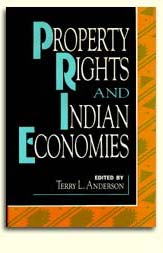
Terry L. Anderson Editor
 Most research on American Indian economies seeking to explain why Indians have remained near the bottom of the economic ladder has concentrated on resource endowments. This approach has focused policy attention on creating government programs to expand resource exploitation either by encouraging non-Indians to develop reservation resources or by directly enhancing reservation physical and human capital. However, these policies have ignored institutions and the important role of local customs and privileges. This book explicitly considers this institutional context and focuses on the rules that determine who controls physical and human resources and who benefits from their use. The authors consider the three main ingredients necessary for successful economies: stable government, minimal bureaucracies, and the rule of law.
Terry L. Anderson is the executive director of PERC and a professor of economics at Montana State University.
Rowman & Littlefield Publishers, Inc.
4720 Boston Way
Lanham, MD 20706
800-462-6420
www.rowmanlittlefield.com
1992; 256 pp.