Introduction
Across Montana, water shapes the state’s landscapes and defines its livelihoods. Cold, clear streamflows support world-class fisheries along iconic rivers such as the Madison, the Yellowstone, and the Flathead, anchoring a sector worth $1.5 billion annually.1Jeffrey Michael, Derek Sheehan, and John Baldridge, Economic Contribution of Cold- and Warm-Water Fishing in Montana (Bureau of Business and Economic Research, University of Montana, 2025), https://www.bber.umt.edu/pubs/econ/MT-Fishing-Econ-Impact.pdf. More than 2.15 million acres of irrigated land generate nearly $800 million each year in crop production.2Montana Department of Natural Resources and Conservation, Montana Statewide Irrigation Dataset, April 4, 2024, https://mslservices.mt.gov/Geographic_Information/Data/DataList/datalist_Details.aspx?did=%7Bf33bc611-8d4e-4d92-ae99-49762dec888b%7D; Nick Hagerty, “The Economic Value of Irrigated Agriculture in Montana,” Ag Econ MT, February 3, 2026, https://www.montana.edu/ageconmt/newsandposts/economicvalueirrigatedagricultureinmontana.html. A population of 1.1 million people depends on Montana’s rivers, lakes, and aquifers to meet their everyday needs. Numerous industries also rely on the state’s water. Yet this critical resource is increasingly under threat. Climate change is decreasing Montana’s snowpack, causing earlier snowmelt runoff, and shifting precipitation patterns, all resulting in less reliable streamflows during the summer months when demand is highest. These challenges are expected to worsen in the coming decades.3Cathy Witlock, Wyatt F. Cross, Bruce Maxwell, Nick Silverman, and Alisa A. Wade, 2017 Montana Climate Assessment (Montana State University and University of Montana, Montana Institute on Ecosystems, 2017, https://live-mca-site.pantheonsite.io/sites/default/files/thumbnails/image/2017-Montana-Climate-Assessment-lr.pdf. More frequent and intense drought will compound challenges for what is already the most drought-vulnerable state in the West.4Johanna Engström, Keighobad Jafarzadegan, and Hamid Moradkhani, “Drought Vulnerability in the United States: An Integrated Assessment,” Water 12, no. 7 (2020): 2033, https://doi.org/10.3390/w12072033. Montana will struggle to meet the growing water demands from its many users.
The usual suspects for managing water shortages in the American West are politically, economically, and environmentally incapable of solving today’s water problems. Supply-side approaches have historically included damming rivers to build reservoirs, piping in water from distant water-abundant sources, and drilling wells to pump groundwater. Demand-side strategies have often centered on conservation mandates and water use restrictions. New tools are needed to do more with less to solve the Treasure State’s “wicked” water woes.
Market mechanisms are emerging as cooperative improvements to the conflict-ridden water management tools of the past. In a water market, participants can buy, sell, and lease water rights to reallocate them to their highest-valued uses. These voluntary transactions can free up water for users who value it most, rather than keeping them locked in a rigid management system. Markets also encourage greater conservation by making the opportunity cost of water tangible: water used is water that could have been sold, which means users have a financial incentive to eliminate waste. Water markets are, however, still in their early stages. High transaction costs have discouraged participation by making it difficult to execute trades that make sense economically and environmentally. This report investigates water market barriers in Montana and puts forth practical solutions to overcome them.
Policy Recommendations
- Complete Montana’s general stream adjudication and strengthen enforcement institutions to clarify and protect water rights.
- Reduce barriers to voluntary transactions to reallocate water to environmental needs.
- Provide market-based alternatives to exempt wells in high-growth, water-scarce regions.
- Modernize water management with satellite-based technologies.
Defining and Enforcing Water Rights
A general understanding of economic property rights provides context for understanding water rights.
Water Rights
An economic property right establishes ownership over a given resource—water, in the case of water rights—and gives the owner the ability to choose how that resource is used. Three essential characteristics of property rights are use, exclusion, and transferability. Use refers to how the resource may be used. Exclusion lets the owner make use of the resource without interference from others. Transferability allows the owner to sell, lease, or otherwise transfer the right to someone else.
A water right is a particular type of property right that permits the owner to make use of a publicly owned water resource, to the exclusion of others who might use that same water, with the ability to transfer the water right to others through sale or lease. In the American West, water rights are governed by the prior appropriation doctrine. Under this “first-in-time, first-in-right” system, whoever first diverts water and applies it to a beneficial use establishes a water right with a priority date reflecting that original claim. All users who subsequently lay claim to water from the same source are assigned a later priority date, creating a ranking system based on when use began.
The prior appropriation doctrine dictates how water scarcity is handled. When a water source is insufficient to meet the demands of all water users who have claims on that source, the most senior rights—those with the earliest priority dates—get water first. Junior users must refrain from using their water until senior users ahead of them have satisfied their rights. This occurs through a mechanism known as a “call on the river,” or simply a “call.” A call mandates that upstream junior users curtail their diversions to free up water for downstream senior users. Enforcement of the priority system through calls is essential to ensure that senior water rights holders can fully benefit from their ownership claims.
For water markets to run smoothly, key attributes of water rights should be clearly defined.5Peter W. Culp, Robert Glennon, and Gary Libecap, Shopping for Water: How the Market Can Mitigate Water Shortages in the American West (The Hamilton Project, Brookings Institute; Stanford Woods Institute for the Environment, 2014), https://woodsinstitute.stanford.edu/system/files/publications/market_mitigate_water_shortage_in_west_paper_glennon_final.pdf. These characteristics clarify who owns a water right, how much water can be withdrawn, what water source it draws from, and when use first began. Clarifying the nature of water rights strengthens them by giving more certainty to rights holders about what they are actually entitled to, and by reducing the costs of monitoring and enforcement. Such strengthening lays the groundwork for users to sell or lease their water as they see fit and reallocate a scarce resource to its highest-valued use.
Adjudication
One of the most thorough ways to define water rights is through a general stream adjudication, a judicial process that investigates and verifies claims to water in a given area. Adjudications more precisely quantify water rights, lowering the costs of monitoring and enforcement. A rancher, for instance, might hold an ambiguous right based on little more than a hand-scrawled note from 150 years ago. Through adjudication, the state works with the rancher to award a verified water right that matches actual historical use, giving both the rancher and the state clarity going forward. This is especially important for transferring water in a market, where buyers and sellers need confidence about how much water is being exchanged and how that water can be used. Several western states, such as Idaho, Arizona, and Washington, have undertaken general stream adjudications to bring legal certainty to their water rights. In Idaho, water trading activity increased 140 percent following its Snake River Basin adjudication.6Oliver R. Brown and Xinde James Ji, “The Economic Value of Clarifying Property Rights: Evidence from Water in Idaho’s Snake River Basin,” Journal of Environmental Economics and Management 119 (2023): 102799, https://doi.org/10.1016/j.jeem.2023.102799.
Montana began an arduous general stream adjudication in 1973. The first step in the process is for the Department of Natural Resources and Conservation (DNRC) to verify the details of each water claim. Then, verified claims are passed on to the state’s water court, a specialized branch of the judicial system equipped with water law experts, to issue decrees, resolve objections, and ultimately confirm final water rights.7Montana Department of Natural Resources and Conservation, What Is Water Rights Adjudication?, Water Fact Sheet no. 7 (2015), https://dnrc.mt.gov/_docs/water/Planning_implementation_coor/7_what_is_water_rights_adjudication.pdf. The end result is a well-defined and enforceable set of water rights in every basin, priming Montana for water marketing.
While Montana anticipates it will finish adjudication by 2028, the projected completion date has been delayed repeatedly for decades.8Montana Department of Natural Resources and Conservation, Reserved Water Rights Compact Commission, and Montana Water Court, Water Rights Adjudication, Performance Audit 09P-09 (Montana Legislative Audit Division, 2010), https://archive.legmt.gov/content/Publications/Audit/Report/09P-09.pdf. Indeed, a completion target of 2028 may be overly optimistic; as of April 2026, the water court has issued final decrees in just 18 of 85 basins.9“Basin Status Map,” Montana Department of Natural Resources and Conservation, accessed February 18, 2026, https://dnrc.mt.gov/Water-Resources/Water-Rights/Basin-Status. Until adjudication is complete, many of the potential gains from water policy reform may be infeasible or ineffective. Buyers and sellers cannot confidently transact over rights that are still unverified or wrapped up in adjudication proceedings. To ensure the DNRC and water court stick to schedule, the state should prioritize the funding and resources necessary to finish out the remaining adjudications. Montana is working toward completing a significant investment in a secure and well-functioning water rights system. Getting over the finish line with the help of additional funding and resources will bring the state one step closer to a prosperous water future.
Tribal Water Rights
Montana’s appropriative rights have a priority date coinciding with the date diversions started. One exception is the rights held by the state’s tribes, known as Winters rights. In its 1908 Winters v. United States decision, the U.S. Supreme Court established that creating an Indian reservation reserved water to serve that reservation’s purposes, with a priority date as early as its creation—but the ruling recognized only that these rights exist; it did not create water rights. Instead, Winters rights are typically quantified as state water rights through lengthy negotiations of competing claims between tribes, the federal government, state governments, and individual water users and districts. These negotiations end with a compact agreement that must be ratified by Congress and then enforced by the state.
Montana has taken a proactive approach to resolving these claims. In 1979, the state created the Reserved Water Rights Compact Commission to negotiate settlement agreements without relying on costly and contentious litigation. The commission has successfully concluded all seven of Montana’s tribal water rights compacts, which included folding Winters rights into the statewide adjudication. The Department of Natural Resources and Conservation now implements these compacts through its Compact Implementation Program, a unique and cooperative effort between the state and tribes to administer tribal water rights.
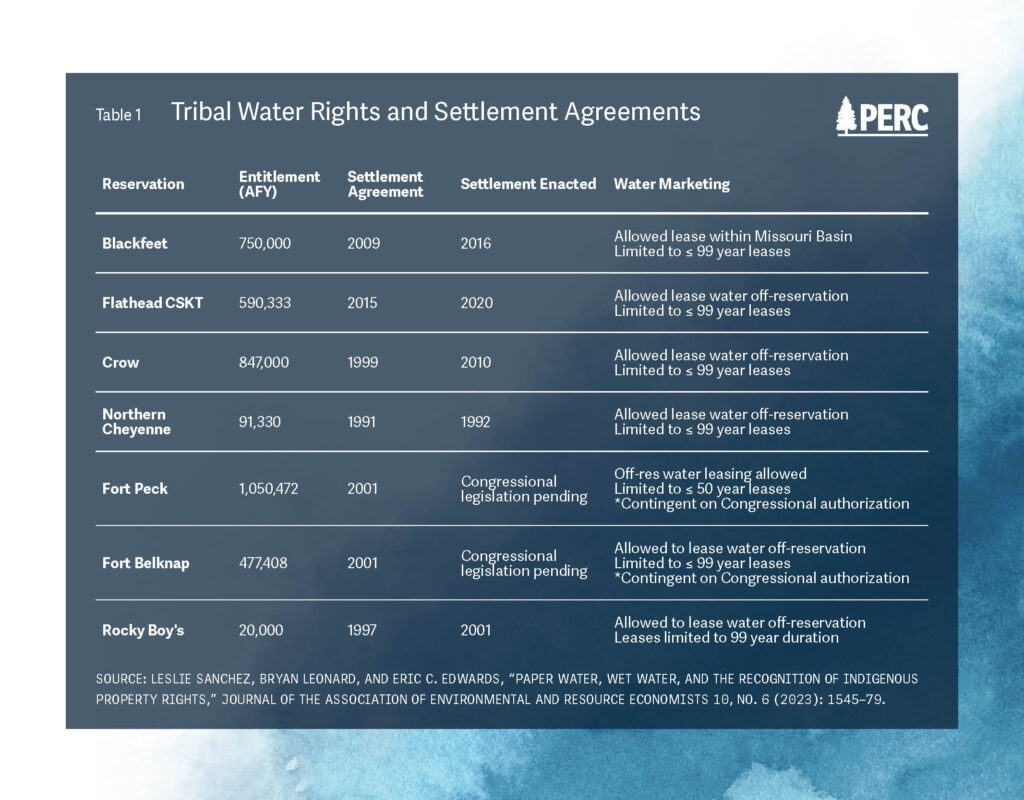
The compacts give tribal governments additional tools to exercise their water rights, including water leasing, which provides flexibility in managing their water as both a natural and financial resource. While all seven tribal compacts have been settled, the Fort Peck and Fort Belknap settlements still require congressional approval. Montana should continue to push federal legislators to ratify these compacts, which will reduce uncertainty over the water right claims and provide legal authority for water leasing, and ensure the DNRC has the resources necessary to successfully implement all the compacts through its Compact Implementation Program.
Water Courts
The Montana Water Court is set to dissolve at the conclusion of the general stream adjudication, having fulfilled its sole purpose. However, the water court can and should still serve a crucial role in the post-adjudication world. District courts currently take on water rights litigation, but generalist judges lack the specialized water law knowledge and experience water judges have acquired through decades of adjudication. District judges have already hinted that they would prefer to stay out of complex water disputes.10 Jason Mohr, HJ 14: Prospects for a Future Water Court (Montana Legislative Services Division, 2020), https://archive.legmt.gov/content/Committees/Interim/2019-2020/Water-Policy/Meetings/Sept-2020/HJ14-report-final-FINAL.pdf. Montana would be wise to permanently tap into the expertise of water judges. The oldest court in the world, after all, is a water court—Spain’s Water Tribunal of the Plain of Valencia, which has settled irrigation disputes continuously for over a millennium.11Margarita Gokun Silver, “Drink in History at the World’s Oldest Court,” Smithsonian Magazine, October 15, 2025, https://www.smithsonianmag.com/travel/drink-history-world-oldest-court-180956951/. A permanent water court can more efficiently handle legal conflicts between water users, leading to faster decision-making and less litigation risk to transfers. Dividing the water court’s jurisdiction among Montana’s four major river basins would alleviate the need for users to navigate multiple district courts when litigation crosses jurisdictions. Colorado, the only state with permanent water courts, structured its courts in a similar basin-by-basin manner. This format allows judges with localized knowledge to efficiently settle disputes and aligns with the prior appropriation doctrine, which determines water rights’ priorities within hydrological, not political, boundaries. Colorado’s water courts have been consistently praised by economists for reducing uncertainty, facilitating transfers, and lowering transaction costs.
Calls and Disputes
Montana’s only administrative procedure for issuing calls during times of scarcity applies to enforcement of instream flow rights owned by Fish, Wildlife, and Parks (FWP), known as Murphy Rights.12Montana Department of Fish, Wildlife, and Parks, Water Right Call Protocol (2022), https://fwp.mt.gov/binaries/content/assets/fwp/conservation/fisheries-management/water-management/fwp-water-right-call-protocol-final-7-22-22.pdf. In practice, however, exercising Murphy Rights has been contentious. In 2021, the governor directed FWP not to make calls on the Smith and Shields Rivers, citing uncertain benefits to instream flows resulting from the calls. In response, FWP attempted to improve the call protocol for state-held instream rights, though that revised process is now being challenged in a lawsuit alleging it imposes unreasonable barriers to enforcement.13Laura Lundquist, “Gianforte stopped FWP effort to bolster streamflow, requires protocol,” Daily Montanan, April 13, 2022, https://dailymontanan.com/2022/04/13/gianforte-stopped-fwp-effort-to-bolster-streamflow-requires-protocol/; Quincey Johnson, “All You Need to Know About the FWP Instream Flow Rights Lawsuit,” Upper Missouri Waterkeeper, August 13, 2025, https://www.uppermissouriwaterkeeper.org/all-you-need-to-know-about-the-fwp-instream-flow-rights-lawsuit/. Outside of this specific context, there is not an established protocol to protect existing water rights. Currently, water users themselves are expected to settle calls with other users. For example, a senior user who’s unable to use their full water right due to insufficient streamflow is encouraged to go directly to a junior user upstream and ask them to curtail their water use until the senior user has satisfied their full share. If this does not resolve the shortage, the senior user can escalate to a district court or petition for a water commissioner to distribute water according to priority, options that are expensive and time-consuming.14Montana Department of Natural Resources and Conservation, How Is Water Managed in the Event of Water Shortages?, Water Fact Sheet no. 6 (2025), https://dnrc.mt.gov/_docs/water/Planning_implementation_coor/6_how_is_water_managed_in_the_event_of_water_shortages.pdf.
This ad hoc enforcement system is not suitable for a state where water demand will continue to outpace supply. Parties may be reluctant to transact water if they are not guaranteed that the water’s new use will be protected from other diverters, or if they must bear high costs in enforcing their rights themselves. To create a robust system of enforcement, the Montana DNRC should adopt an approach similar to the Colorado Division of Water Resources’ administrative call standard. In Colorado, water managers called division engineers track a full picture of the water supply and demand conditions on a given stream segment each day. Supply is modeled from real-time streamflow monitoring, while demand is calculated from the water right entitlements. When demand exceeds supply, division engineers order upstream junior diversions to be curtailed, ensuring that downstream senior users have enough water.15Colorado Department of Natural Resources and Division of Water Resources, Administrative Call Standard (2018), https://dnrweblink.state.co.us/dwr/ElectronicFile.aspx?docid=3600964&dbid=0. Following a similar protocol in Montana will give confidence to buyers and sellers of water rights that their transactions are protected through a transparent, science-based process.
Policy Recommendation
Complete Montana’s general stream adjudication and strengthen enforcement institutions to clarify and protect water rights.
- Provide sustained funding and resources to ensure adjudication is completed on schedule, giving users certainty over their water rights.
- Establish a permanent water court, with basin-based expert judges to resolve water disputes efficiently once adjudication concludes.
- Adopt a formal call system to enforce the priority system amidst growing water scarcity.
Unleashing Environmental Water Transfers
Practical solutions can overcome existing barriers and make it easier to execute water trades that have economic and environmental benefits.
Legal Mechanisms
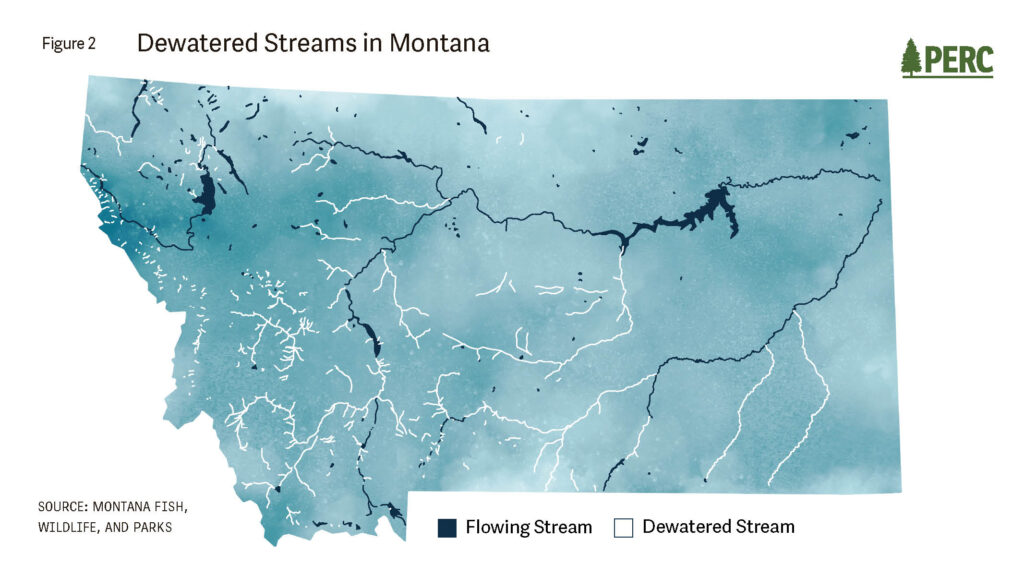
As water supplies grow more variable and demands shift, Montanans need legal mechanisms to temporarily or permanently convert water rights to environmental uses to help restore the state’s over 4,500 miles of chronically or periodically dewatered streams.16Montana Department of Fish, Wildlife, and Parks, Dewatered Streams – Montana (October 2, 2024), https://gis-mtfwp.hub.arcgis.com/datasets/e0849312c41b415992a075f8696164c8_0. Water markets have proven effective at delivering benefits to natural ecosystems in other states. To unleash these market mechanisms in Montana requires two legal components: formal recognition of instream flows as a valid beneficial use of a water right and the legal authority to purchase or lease water rights for this purpose. Together, these mechanisms enable water transfers as an effective way to quickly and voluntarily protect conservation values by leaving water in rivers to benefit ecosystems.
Montana passed legislation in 1995 to address both these requirements. Early statutes enabled private parties and conservation groups to purchase temporary leases of water rights and change their beneficial use to instream flows.17Montana Department of Natural Resources and Conservation, How Are Instream Flows Protected?, Water Fact Sheet no. 8 (2015), https://dnrc.mt.gov/_docs/water/Planning_implementation_coor/8_how_are_instream_flows_protected.pdf. This authority remains limited, however: Private parties cannot permanently convert and hold an instream flow water right. A conservation group seeking lasting protection must therefore repeatedly renew a temporary authorization or donate the underlying right to the state—a tenuous substitute, given a 2025 lawsuit alleging that Montana Fish, Wildlife, and Parks has failed to assert its instream flow rights.18Quincey Johnson, “All You Need to Know About the FWP Instream Flow Rights Lawsuit,” Upper Missouri Waterkeeper, August 13, 2025, https://www.uppermissouriwaterkeeper.org/all-you-need-to-know-about-the-fwp-instream-flow-rights-lawsuit/. Other challenges to environmental transactions include objections and the slow processing of change applications.
A major barrier to transferring water to any new use, including instream flows, is the ability of other parties to object to water right transfers, delaying or preventing voluntary conservation measures. An objection would typically be filed because a transfer may reduce water available to someone else—described as the “no-injury rule” in many western states—leading to expensive delays or even outright cancellations of transfers. The logic of such protests goes as follows: An appropriative water right lists a decreed volume of water based on how much its holder is allowed to divert. After beneficially using the diverted water, such as by irrigating crops, a portion of that water—return flows—returns to the source from which it was drawn, available for use by both senior and junior downstream diverters. When water is moved out of a basin or converted to a new use, these return flows may disappear or be reduced. Montana prohibits transfers from causing such “adverse effects” on downstream users, regardless of seniority.19Jason Mohr, A Right to Stream Conditions as They Existed: A Study of the Process for Changing a Water Right (Montana Legislative Services Division, 2018), https://archive.legmt.gov/content/Committees/Interim/2017-2018/Water-Policy/Meetings/ChangeWRreport-FINAL.pdf.
Montana’s temporary water leasing laws have taken many forms through the years, but the speed with which transfers are processed has remained a challenge. An innovative 2025 bill, SB178, reduces the burden associated with the change application process needed to formally convert a water right to a conservation use. Change applications add prohibitive transaction costs to water transfers through legal fees and complex hydrologic analyses that can drag on for years. Montana’s new water leasing regime requires only a streamlined lease application in lieu of a full change application to encourage more short-term water transfers. This expedited review process is crucial to freeing up water for depleted streams through temporary leasing. When instream flows are needed to improve fish habitat, for example, the faster lease process allows water to be secured quickly enough to support fish during critical low-flow periods, rather than arriving too late to be effective.
SB178 is a positive step toward expanding environmental water transactions, but the bill has its shortcomings: Third parties may still object to instream flow leases. While objections are intended to protect existing water rights holders from transfers that could impair their rights, protests can impose substantial costs even when no actual injury occurs by requiring additional legal, technical, and administrative work. Because leases under SB178 remain in stream, these leases are very unlikely to affect other water rights. To facilitate more frequent and faster conservation leasing, Montana should place a high burden of proof on objectors to instream flow leases. Protests that do not meet this standard should be discarded, resulting in a smoother leasing process and more transactions for instream flows.
Irrigation Organizations
Irrigation organizations, such as canal companies, irrigation districts, and mutual ditch companies, supply roughly 70 percent of agricultural water in the western United States, playing a critical role in future water reallocation.20Nicholas A. Potter, R. Aaron Hrozencik, and Steven Wallander, Irrigation Organizations: Water Inflows and Outflows, Economic Brief no. 36 (U.S. Department of Agriculture, Economic Research Service, 2023), https://dx.doi.org/10.32747/2023.8134139.ers. These entities are typically structured such that the organization acquires water rights and issues shares of these rights to farmers located within its service boundaries. Water is then delivered to shareholders through a system of canals and reservoirs, whose construction and maintenance are funded by user fees. This structure has allowed for the acquisition and conveyance of water supplies and helped support robust agricultural communities in Montana.
The unique characteristics of irrigation organizations present both constraints and opportunities for water conservation markets.21Andrew Ayers and Daniel Bigelow, “Engaging Irrigation Districts in Water Markets,” in The Future of Water Markets: Obstacles and Opportunities, ed. Eric Edwards and Shawn Regan (Property and Environment Research Center, 2022), https://www.perc.org/wp-content/uploads/2022/09/PPR-Water-Markets-220916-WEB.pdf. Because water rights are held by the organization and distributed among its users as shares, rather than owned individually by farmers, those who wish to sell or lease their water must work through the organization’s governance process. Bylaws often require the consent of other shareholders when transferring water outside of a district or service area, and may also prevent transfers to uses other than irrigation. While these rules reflect the collective decisions of the organization’s members, they can limit the ability of individual farmers to participate in water markets.
Organization members face legitimate concerns about the impacts of water transfers. When water is reallocated to outside parties, return flows may be altered in timing or location, affecting other shareholders. Infrastructure costs to maintain irrigation and water delivery systems must still be covered, even if fewer acres are irrigated. Large-scale transfers can reduce agricultural production and strain local economies—fueling resistance to what is often called “buy and dry.”
To overcome these obstacles and unlock irrigation organizations as key conservation partners, organizations should adjust their bylaws to allow for transfers to environmental uses. To incentivize these transactions, lessees should structure lease payments to compensate both the participating irrigator and the organization, ensuring that required assessments and maintenance budgets remain whole during lease periods. Irrigation groups can also play an active role in conservation by aggregating small volumes of water from willing members, verifying consumptive use, and managing return flow concerns internally before water is transferred outside the service area. Finally, emphasizing short-term arrangements where local communities can set limits on how much water can be transferred can help irrigation organizations augment local instream flows while keeping land in production and maintaining the viability of rural communities.
Tribal Water
Montana’s seven tribal water rights compacts quantify substantial volumes of water, as shown in the table below. When the compacts were negotiated, each one expressly allowed for off-reservation leasing of Winters rights. Tribes thus have the potential to play significant roles in environmental water transfers, subject to compact-specific requirements and remaining congressional approvals for the Fort Peck and Fort Belknap Reservations. Mutually beneficial contracts to lease water for instream flows from tribal water users can generate substantial revenue for reservations, give reservations greater sovereignty over their natural resources, and improve streamflows for conservation values. Such agreements are already taking place in multiple areas within the Colorado River Basin, where tribal leasing and forbearance agreements have helped maintain Lake Mead levels while financially benefiting participating tribes.
To date, Montana has not faced the same level of basinwide scarcity that has driven tribal water marketing in the Southwest. But as drought risk, population growth, and seasonal streamflow pressures increase, Montana’s compact framework could become an important source of flexibility. Tribal water rights carry priority dates that predate state appropriations, making them highly valuable. The Compact Implementation Program can help turn tribal marketing provisions into workable practices by advising on compact-specific leasing requirements and staying on track with bringing compacts to fruition. Tribes may find it worthwhile to explore where leasing makes financial sense, and conservation groups have an opportunity to build relationships with interested tribes and work toward win-win transactions.
Policy Recommendations
Reduce barriers to voluntary transactions to reallocate water to environmental needs.
- Place a high burden of proof on objectors to temporary water transfers to instream flows, preventing unnecessary delays to transactions that do not materially harm downstream users.
- Reform irrigation organization bylaws to permit environmental water transfers and structure leases to compensate both individual irrigators and the broader organization.
- Support tribal leasing of water for instream flows, with the Compact Implementation Program helping interested tribes navigate compact-specific requirements.
Managing Groundwater Efficiently
Groundwater is a critical component of Montana’s water system, supplying users and supporting uses statewide, including 95 percent of rural homeowners.22Montana Department of Natural Resources and Conservation, Can Groundwater Meet the Demand for New Water Uses in Montana?, Water Fact Sheet no. 4 (2025), https://dnrc.mt.gov/_docs/water/Planning_implementation_coor/4_can_groundwater_meet_the_demand_for_water.pdf. Although often treated as a separate resource, groundwater is hydrologically connected to surface water. Pumping from underground aquifers can reduce streamflows, affecting senior surface water rights and ecosystems alike, and surface diversions can reduce groundwater recharge and water availability to pumpers. Montana recognizes this connection in most permitting contexts, requiring that new groundwater appropriations not injure existing surface water users. There is, however, a significant exception: exempt wells.
When Montana enacted the Water Use Act in 1973, it included a provision allowing anyone to drill a well and pump up to 10 acre-feet per year without applying for an appropriative water right or demonstrating no injury to other rights holders.23Montana Department of Natural Resources and Conservation, History of Exempt Wells in Montana – an overview, https://dnrc.mt.gov/_docs/water/Comprehensive-Water-Review/MAIN.PAGE.CONTENT/Exempt-Wells-History.pdf. The exemption was conceived as a practical accommodation for small-scale uses—such as rural homes and livestock—where the costs of permitting would far exceed any plausible harm caused. Exempt well users do not need to verify that the water legally and physically exists, notify nearby rights holders of their well, or attach a meter to monitor extractions. There is also no opportunity for users with fully decreed water rights to protest exempt wells to protect their own property rights.24“Exempt Well Fact Sheet,” exhibit 14, HB 642, Montana House Natural Resources Committee, 2023, https://archive.legmt.gov/bills/2023/Minutes/House/Exhibits/230222NAHa14.pdf.
For isolated, low-impact uses in water-abundant areas, the logic of exempt wells still holds. Other western states have made similar accommodations for the same reasons. A single household drawing from a deep aquifer in a remote valley with no competing users is unlikely to harm anyone, and requiring that household to go through a multi-year permitting process to secure water would be inefficient. The problem is that Montana applies the same blanket exemption even in over-appropriated basins known to face significant scarcity.
More than 140,000 exempt wells have been drilled throughout the state, at least half of which are built in basins closed to new water rights. In regions like the Gallatin and Bitterroot Valleys, exempt wells are drawing down aquifers hydraulically connected to rivers, reducing surface flows as well as groundwater that permitted users depend on during the driest months. Because exempt wells require no permit, no injury analysis, and no monitoring, their withdrawals exist entirely outside of the prior appropriation system. What appear to be individually small extractions add up to a significant depletion of a shared resource.
Many western states have tightened regulation of exempt or domestic wells in areas experiencing groundwater depletion or conflicts with senior users, including by limiting new exempt wells, requiring permits, imposing mitigation requirements, or authorizing local restrictions. Montana policymakers and regulators have long recognized the need to restrict exempt wells in fully appropriated basins. Rules governing “combined appropriations” were developed in response to lawsuits to ensure that multiple wells serving a single housing development are evaluated collectively rather than individually. Recent unsuccessful legislative proposals have sought stricter volume limits, required metering and reporting, and tiered restrictions in water-stressed basins, and similar efforts will be put forth during the 2027 legislative session.25Amanda Eggert, “Bill to Overhaul Exempt-Well Use Stalls in Montana Senate,” Montana Free Press, April 3, 2025, https://montanafreepress.org/2025/04/03/bill-to-overhaul-exempt-well-use-stalls-in-montana-senate/; Water Policy Interim Committee, The De Minimus Exception to the Permit Process, 2026, https://archive.legmt.gov/content/Committees/Interim/2025-2026/WPIC/March_26_27_2026/ExemptWells_de_minimis_exception_framework2026.03.04.pdf. A current lawsuit before a Montana district court seeks to ban exempt wells outright.26Montana League of Cities and Towns et al. v. State of Montana and Department of Natural Resources and Conservation, complaint for declaratory and injunctive relief, No. DV-25-2025-0000710-DK, Montana First Judicial District Court, Lewis and Clark County, November 12, 2025, https://westernlaw.org/wp-content/uploads/2025/11/2025.11.12-Exempt-Wells-Complaint.pdf.
Restricting exemptions to maintain a functioning water rights system will be more palatable if there exist practical alternatives for rural landowners and residential developers to secure other sources of water. In Montana’s most stressed basins, new appropriations are technically possible if an applicant offsets their depletion through mitigation. Mitigation begins when a current water right owner files a change of use on their right to a mitigation purpose. They can then market that right to new entrants such as developers, who purchase and retire it to allow for new water use. This approach, however, is so expensive, time-consuming, and complex that few parties have successfully endured it. The change process on a mitigation right is uncertain and entails significant hydrological analyses to quantify a right’s mitigation potential. Matching new water use with an equivalent mitigation right in quantity, timing, and location further complicates planning.
Mitigation banks, when established properly, address this problem by doing the hard part: The bank acquires a mitigation water right upfront, completes the cumbersome change application to repurpose it for mitigation, then retires it. New water users can then purchase credits from the bank to offset their new depletions.27Western States Water Council. Groundwater Workshop. 2025. https://westernstateswater.org/wp-content/uploads/2025/01/H-1-Final-Draft-Groundwater-Workshop-Report.pdf
Mitigation banking presents a pragmatic, market-friendly solution that balances acknowledgment of a limited resource with sustainable development. To ensure a successful banking program, some basic structures and rules should be established; many of these lessons glean from mitigation banking successes and failures in Washington and Oregon.28Laura Ziemer and Ada Montigue, Can Mitigation Water Banking Play a Role in Montana’s Exempt Well Management? (Trout Unlimited, 2011), https://archive.legmt.gov/content/Committees/Interim/2011-2012/Water-Policy/Meeting-Documents/September-2011/mitigation-banking-tu.pdf Independent banks should operate within particular basins to take full advantage of the local knowledge that stakeholders within these areas possess. Water users who sell their rights to a bank should be fairly compensated at rates reflective of market conditions. Likewise, credits bought by developers should be priced in alignment with the costs associated with acquiring water rights and converting them to mitigation purposes, with the ability to adjust rates as more information is gathered through water banking transactions. These rates should be set with full public transparency to avoid unusually high prices that discourage participation, as happened with the Kittitas Water Exchange in Washington. Ultimately, the success of mitigation banking in Montana will depend on building a solid foundation from the outset.
Policy Recommendations
Provide market-based alternatives to exempt wells in high-growth, water-scarce regions.
- Make mitigation banks a viable alternative to exempt wells in closed basins.
- Reduce market barriers to allow new users to purchase or lease existing water rights to meet growing demands.
Modernizing Measurement and Data
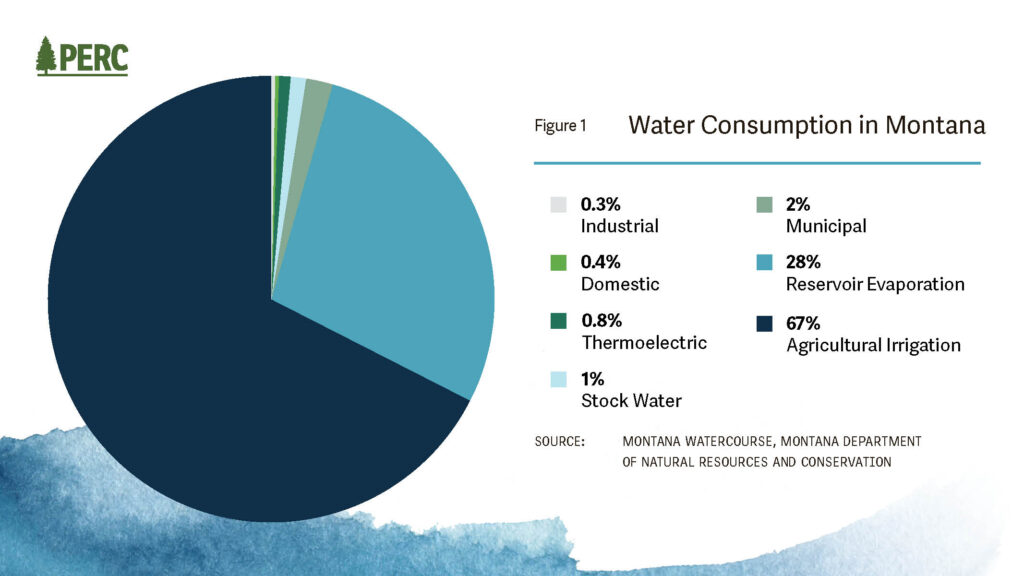
As with the rest of the West, irrigated agriculture dominates consumptive water use in Montana, accounting for roughly 68 percent of all depletions.29Montana Department of Natural Resources and Conservation, How Much Water Is There and How Is It Used?, Water Fact Sheet no. 3 (2015), https://dnrc.mt.gov/_docs/water/Planning_implementation_coor/3_how_much_water_is_there_and_how_is_it_used.pdf. Thus, efforts to reallocate water through market transactions will largely depend on partnering with farmers. These efforts, however, suffer from a key information gap. In Montana, only the consumptive use portion of a water right—the share of diverted water that does not return to its source—is transferable, rather than the whole diversion amount. This quantity cannot be directly measured by physical devices such as gauges, and attempts to estimate it through other methods are often inaccurate or not carried out at the individual field level. The Montana DNRC’s current approach to quantifying consumption relies on outdated information interpolated to fields from nearby weather stations, failing to account for the unique, real-time conditions faced by irrigators. When the state underestimates consumption, a seller can transfer less water they actually use, stranding part of the value of any transaction. When it overestimates consumption, transferred water comes at the expense of returns flows that downstream users depend on. In either case, buyers and sellers lack confidence that the state’s estimates accurately reflect the true consumptive use available for transfer.
Improvements in technology can bridge this information gap, resulting in less time arguing over baselines and more time negotiating prices and terms. These advancements leverage remotely sensed evapotranspiration (ET) to estimate consumptive water use all the way down to the field level in real time. Evapotranspiration can be thought of as “reverse precipitation”: It is the total amount of water that evaporates and transpires from soils and crops into the atmosphere. Evapotranspired water then moves to a different hydrological basin, resulting in less water available in the source it came from.
Montana may not need much convincing to adopt evapotranspiration-based methods for measuring transferable volumes. DNRC officials acknowledged during a 2022 stakeholder working group meeting that their current protocol is outdated and recommended utilizing OpenET—an open-source platform making satellite-based ET data easily accessible—to determine historic consumptive use during change applications.30David Ketchum, “Historic Consumptive Use Analysis with Remote Sensing,” memorandum to Anna Pakenham-Stevenson, Montana Department of Natural Resources and Conservation, 2022, https://repos.dnrc.mt.gov/esri/hub/water_processes/pdfs/changes,%20mitigation,%20exceptions/9.27.22_meeting/remote_sensing_historic_use_memo.pdf. Moreover, the agency already allows users to petition to use their own methodology, such as satellite-derived estimates, demonstrating an openness to better depletion estimation techniques.31Montana Department of Natural Resources and Conservation, Application to Change a Water Right: Historical Use Addendum, Form No. 606P/606-HUA, revised February 2025, https://dnrc.mt.gov/_docs/water/Water-Rights-Forms/Form-606-HUA-Historical-Water-Use-Addendum.pdf.
Despite the 2022 discussions, the DNRC has yet to officially embrace evapotranspiration-based measurement of water rights. More accurate measurement reduces key frictions in monitoring, enforcing, and transferring appropriative rights, and the technology is ready. Montana should thus establish clear technical standards for using satellite evapotranspiration data to estimate consumptive water use for transfers. These standards should include the specific ET model and estimation methodology. OpenET houses six different models for estimating the amount of water evapotranspiring from a given field, as well as an ensemble model that combines all six. Each model’s strengths and weaknesses should be carefully evaluated to determine which is best to use under what circumstances. Likewise, there are numerous methods for parsing out the portion of total ET that comes from irrigating crops, and Montana should work to determine which is most appropriate.
Along with standardizing a model and a method, investing in ground truthing can help demonstrate the viability of remotely sensed evapotranspiration and assess its accuracy in estimating depletion. Eddy covariance flux towers are a proven means of verification, capturing real-time and highly accurate measurements of field-level ET through specialized ground-based instruments. Comparing flux tower measurements against OpenET outputs across different crop types, irrigation systems, and climatic conditions would build the body of evidence needed to justify and defend the use of satellite-based technology in water rights management.
Finally, Montana should pursue pilot opportunities to test the use of remote sensing in measuring water consumption. A pilot program could target a geographic region and deploy OpenET for a specific type of transfer, such as instream flows. Utah provides a topical example of how to do this. Water managers pursuing a lease to deliver water to the Great Salt Lake recently worked with a willing farmer to use OpenET during a change application to determine the transferable volume of the right, rather than using the state’s standard method based on regional tables published in 1994.32Utah Division of Water Rights, Technical Services, “Depletion Estimate for Change Application f53436,” 2026, https://www.waterrights.utah.gov/docImport/0680/06803814.pdf. In Montana, engaging stakeholders early, as Utah has done, would help identify practical barriers to adoption while building trust in the technology.
Policy Recommendation
Modernize water management with satellite-based technologies.
- Adopt standardized methods using satellite evapotranspiration data to quantify consumptive water use for transfers.
- Support ground truthing and pilot projects to validate these tools and build confidence among regulators and water users.
Conclusion
Montana’s water challenges are real, but so are its opportunities. The old adage “whiskey is for drinking, water is for fighting” can be a thing of the past by tackling water scarcity through markets. The good news is that the state does not need to overhaul its water management. Its prior appropriation system already provides a foundation for allocating water to beneficial uses; the task now is to make that system work more effectively under modern conditions. By strengthening water rights through clarity, removing barriers to voluntary transfers, making it easier to mitigate groundwater development, and bringing measurement into the 21st century, Montana can better adapt to changing supply and demand without resorting to costly or rigid interventions.
The reforms presented in this report are practical steps toward a thriving water market. Completing adjudication will provide the certainty needed for water users to confidently participate in transfers. Strengthening enforcement institutions will ensure that those rights are meaningful in times of shortage. Reducing obstacles to voluntary transactions can expand opportunities to meet growing demands without undermining existing users. Establishing clearer property rights to groundwater is necessary to prevent a tragedy of the commons and bring in more market participants. Improving water measurement through innovative technologies gives better information to help water markets flourish.
Taken together, these changes would allow Montana to make more efficient use of its limited water resources. Rather than relying on forced allocation or costly augmentation, a more functional system of water rights and voluntary exchange can balance environmental, agricultural, municipal, and industrial needs. In Montana’s water future, cooperation can replace conflict.