
Rome was not built in a day, but a beaver dam can be. Nature’s engineers can build durable dams very quickly, and maintain them over time too, slowing down (not blocking) and storing water, allowing sediment to settle, and even mitigating wildfire risk. In one case, beavers built dams downstream of a wastewater treatment facility in Oregon and cut the heavy metal load by half. This fast, free stream restoration led by beavers stands in stark contrast to the human alternative. It can take years for people to build a so-called beaver dam analogue, not because it’s complicated—it’s not; some practitioners call it “putting sticks in a creek,” which is pretty accurate—but because it requires a slew of permits from different agencies that can take years. That’s a stark contrast: It takes one day to build, but years to permit, and this issue isn’t unique to beaver dam analog projects.
To achieve the abundance of nature that conservation and restoration communities seek, we will need to increase the number, move from pilot to large-scale, and accelerate ecological restoration and stewardship projects like the ones mentioned above. Yet most environmental laws and regulations were not crafted to expedite, or even review, such projects, even though they are reliably positive for nature. Instead, these nature-positive projects are subjected to the same procedures as projects that damage nature. This is backward and counterproductive.
These regulatory challenges for restoration are not restricted to the U.S.—from restoration professionals foregoing high-benefit sites in Australia, to a dune restoration project in France facing deforestation penalties—global examples abound.1Foster, R. and Bell‐James, J., 2024. Legal barriers and enablers to upscaling ecological restoration. Restoration Ecology, 32(7), p.e14203. We are in the U.N.-declared “Decade of Restoration,” and despite the success the restoration community has achieved, the pace of restoration still lags behind that of habitat destruction. We need to regulate and permit ecological restoration projects differently from development, and much faster. The European Union is trying to crack this nut through its Nature Restoration Law, an attempt to streamline and accelerate restoration efforts to restore 30 percent of degraded ecosystems by 2030. In the U.S., permit reform momentum is building across the federal and state levels, but it’s primarily focused on speeding up permitting for infrastructure, energy, and housing. Restoration needs to be part of this conversation, and throughout this piece, we explain why.
Examples of fast nature recovery following a slow human permitting process
This dichotomy between rapid nature recovery and grinding human processes is widespread, and deeply frustrating for the conservation and restoration communities, which seeks to make nature more abundant. For example, it took decades2https://www.sustainablenorthwest.org/klamath-basin-dam-timeline and hundreds of regulatory documents3https://klamathrenewal.org/regulatory/#16874744371seek96-66a7ba08-f693 to bring down the handful of aging dams4Beaver dams and man-made dams are not the same thing. Beaver dams slow down water, not block it, and reconnect rivers to their floodplains. Man-made dams do block water, hold back sediment, and prevent migratory and resident fish species from accessing upstream sections of the river. on the Klamath River that had long been blocking the return of salmon; yet the day after the debris from the last dam was cleared, a returning salmon swam past the removal site, showing us just how responsive nature is if we allow it. Now, for the first time in a hundred years, there are tens of thousands of baby salmon growing in tributaries far upstream, a recovery so rapid that it has left fisheries biologists stunned and thrilled.5Goldfarb, 2025. A River Reborn: Eco-Cultural Revitalization on the Klamath. Accessed May 1, 2026.
Likewise, prescribed burning, a key tool used in fire-adapted ecosystems to both manage risk and increase nature benefits like biodiversity,6Puig-Gironès, R., Palmero-Iniesta, M., Fernandes, P.M., Oliveras Menor, I., Ascoli, D., Kelly, L.T., Charles-Dominique, T., Regos, A., Harrison, S., Armenteras, D. and Brotons, L., 2025. The use of fire to preserve biodiversity under novel fire regimes. Philosophical Transactions of the Royal Society B: Biological Sciences, 380(1924). typically takes three to five years to permit,7 https://www.perc.org/wp-content/uploads/2022/06/PERC-PolicyBrief-NEPA-Web.pdf but can be implemented in a single day and start yielding benefits for public safety and ecosystems immediately. Poignant examples abound showing the perverse outcomes of delayed forest restoration projects. The Antelope fire of 2021 burned through parts of the Klamath National Forest, including habitat for the northern spotted owl, a species listed as threatened under the Endangered Species Act. Ten years earlier, the U.S. Forest Service had identified the same areas for fuels treatments under the Pumice Project. Unfortunately, the project was litigated for a decade based on purported damage to owl habitat, and was just beginning when the fire ignited, scorching over 100,000 acres that more timely intervention might have spared.8https://www.perc.org/2023/10/03/a-summer-of-forest-litigation/
The Time Tax
Our permitting processes, which champion procedure over outcomes, have become the biggest bottleneck for nature restoration. Regulations were designed to preserve current conditions and assume that human actions are inherently harmful to the environment. Yet restoration is all about humans taking action to improve on the status quo. Ecological restoration helps a degraded, damaged, or destroyed ecosystem recover, with the ultimate goal of yielding a permanent stream of nature benefits from the restored natural capital stock. Yet environmental regulation subjects restoration projects to the same scrutiny and resulting “time tax” and other regulatory burdens as projects that harm nature. Here are some specific ways that restoration projects are penalized rather than rewarded.
First, subjecting nature-positive projects to the procedural “time tax” matters. It often means years of delay for restoration projects and substantial costs in planning and permitting processes.9EPIC. 2023. Why are We Spending ⅓ of a Restoration Project’s Funding on Permitting? Accessed May 1, 2026 At 3–4 percent annual inflation, a three-year delay produces an almost 15 percent increase in project costs beyond what was initially budgeted. The costs of expert labor needed to move the project through the permitting system add up too, whether in-house or external. That’s why permitting processes consume roughly 30 percent of total budgets, and sometimes much higher. (For example, they took 50 to 150 percent of project budgets in one study of wet meadow restoration in California.10Bowman, A., Taylor, M.H., Reed, C., Morra, B. and Sullivan, B.W., 2025. Assessing the financial viability of meadow restoration-based carbon projects in the Sierra Nevada and Great Basin, USA. Journal of Environmental Planning and Management, 68(9), pp.2070-2091.) If these costs could be reduced, much more actual restoration could take place—we’re big on spending money on nature, not on paperwork.
This perverse permitting penalty not only slows restoration but causes practitioners to favor interventions and sites that are easier to permit, rather than ones that are more ecologically significant. In addition, extensive permitting paperwork means that many restoration projects simply don’t pencil out financially. We simply can’t measure what the loss of these “missing” restoration projects is, ecologically.
Maddeningly, voluntary restoration sometimes leads to compensatory mitigation requirements when converting a degraded habitat type into a restored one, despite the net gain for nature, because the regulators assume all habitat, even degraded ones, must be blindly protected from change, even if the change is positive for nature. How does this happen? The way we regulate unavoidable harm to nature is through the use of compensatory mitigation. So when a developer wants to fill a wetland to build a mall and parking lot, it will likely have to pay for some type of compensatory mitigation—whether by purchasing advanced mitigation credits, putting money into an in-lieu fee program, or funding a restoration project on, adjacent to, or within the area of impact. Today, these same rules apply to projects to make more wetlands via restoration. This ecological myopia creates friction, misunderstandings, and delays.
And while nature recovery can be rapid, many projects need years to achieve their full ecological benefits —we’re not constructing a building; we’re assisting the recovery of ecosystems, which needs time and support to mature. The additional years of procedural delays add to the recovery timeline, creating a widening gap between ongoing nature loss and recovery.

Why Restoration Needs Its Own Rules
The environmental gains of the past 50 years, attributable to a mix of rising incomes, state actions, and federal law, are real and worth protecting. We’ve literally witnessed rivers transform from open sewers into healthy systems. But decades of accumulated procedural plaque have turned regulations built to protect nature into obstacles to restoring it.
Current laws and regulations allow restoration opponents to effectively veto projects, despite their net goods for society more broadly. Just as some people will oppose a local housing project because of concerns about traffic, parking, aesthetics, or local property values, there are those who want local ecological conditions to stay the same. From smoke impacts and escape risks from prescribed fire to conflicts with restored beavers when they block road culverts, gnaw prized riparian trees, or build dams that occasionally burst and deliver wood downstream, these impacts are real. But these can and should be efficiently mitigated, rather than used as justification for project vetoes. For example, when beavers move onto neighboring private property from a restoration site, pond leveling devices and extension services should be provided to mitigate flood risk and help people co-exist with beavers. And such damage mitigations for landowners should not, in turn, be subject to yet more permitting requirements.
What can be done to speed beneficial projects for nature? A grand political bargain to replace environmental proceduralism is deeply uncertain, so in the interim, incremental reforms focused on sensible exclusions and exemptions are the more realistic path.
Perhaps the lowest-hanging fruit for restoration regulatory reform is for so-called “process-based” restoration projects, designed to mimic a natural beneficial process in a local ecosystem. Our current regulatory system stalls two types of process-based restoration: first, human actions that can restore self-sustaining natural processes, producing new ecological “income”; second, human actions that can serve as substitutes for self-sustaining natural processes, paying down ecological “debt.” We tackle each in turn, and then identify joint policy solutions.
Problem 1: Delayed Ecological “Income”
Perhaps the most frustrating case of nature-positive projects being hampered by permitting is when limited human interventions can restore self-sustaining natural processes. Afterward, the ecosystem will independently function and provide nature services. Such “process-based restoration” is extremely efficient in terms of making the most of limited conservation resources—time and money. It’s akin to building a self-fixing, self-driving, self-powered car. And if we could just build the darn thing faster, it would be out there covering miles on its own. If we think of the nature benefits that these projects produce as valuable “income” from an ecosystem, then procedural delays defer an ongoing ecological income stream. Examples of this kind of restoration include:
- Reintroducing and restoring beavers means they build and maintain dams that slow down the flow of water and create freshwater wetlands, wet meadows, and riparian complexes. Results include increased flood storage capacity, decreased wildfire risk, and filtered water. Once a project has helped beaver populations establish, they will do all of the dam-building and water-management activities that produce the above benefits, for free, with no need for humans to intervene.
- Building beaver dam analogues (human-built beaver dams), which mimic beaver activity, helps restore native riparian vegetation and water tables at degraded sites. Once conditions improve, beavers can recolonize successfully on their own, if there is a nearby population.
- Removing small human-made dams restores river function almost immediately. Once dams come down, aquatic connectivity is restored, and more natural sediment regimes are activated that create new freshwater wetlands and help connect rivers to their floodplains. Migratory fish like salmon and river herring can swim upriver again almost immediately, and they will do so every year in perpetuity, bringing their nutrients into the ecosystem and feeding people and wildlife alike.
- Assisting the establishment of coastal mangroves, salt marshes, and oyster reefs restores living structure to coastal ecosystems starved of complexity. Once established, these living structures will self-sustain and even compound and grow over time, slowing down or reversing coastal erosion, increasing local biodiversity, and protecting inland infrastructure from storm surge and flooding. Without action, tidal wetlands and coastal habitats are disappearing under rising seas, taking their benefits with them.
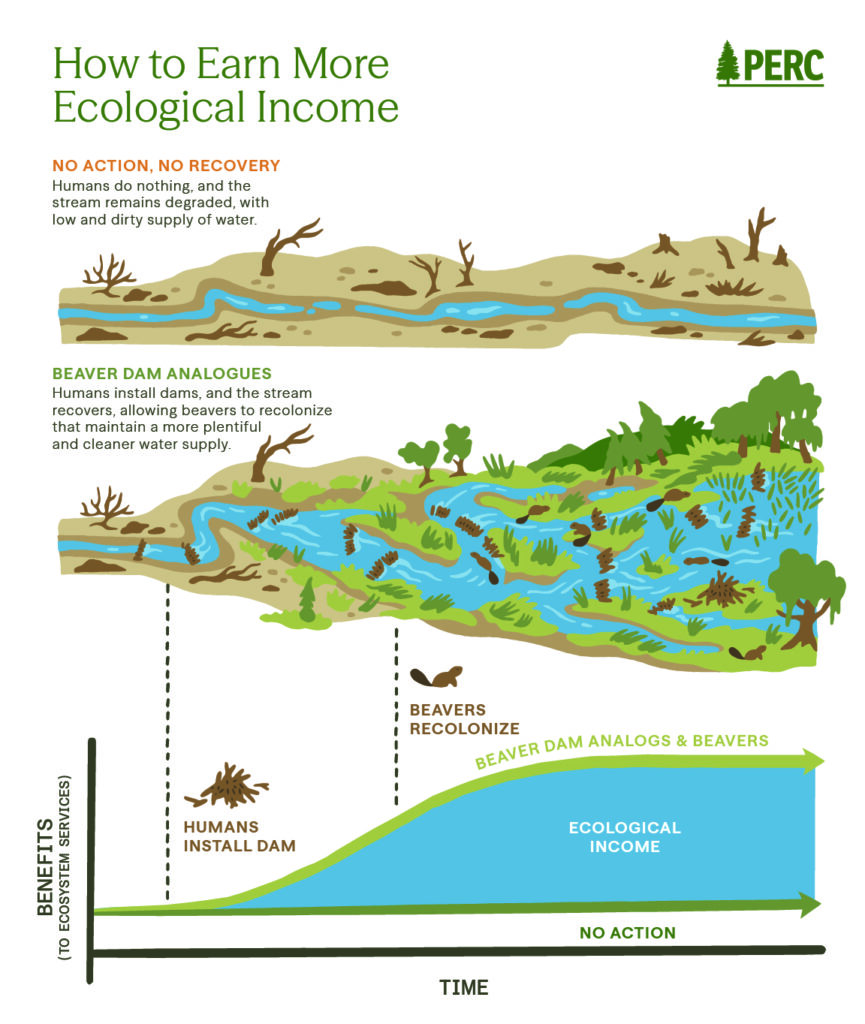
In these cases, the ecological process only needs humans to unblock or enable it, not sustain it through time. It’s a tragedy that we can’t move faster because, in most cases, such projects are eventually permitted to proceed. But the long timeline for approval means missing out on years of benefits—ecological “income”—that restored ecosystems yield upon project completion. Most of these restoration projects require various federal, state, and local permits because most regulations don’t have clear guidance that helps distinguish restoration from development. For example, regulators consider many riparian and aquatic restoration efforts to constitute “fill” under the Clean Water Act, generating more red tape. In most states, restoration permitting takes years—if the permit applicant doesn’t walk away and abandon the project in the meantime.
Problem 2: Mounting Ecological “Debt”
In contrast, some restoration projects require ongoing human interventions and resources. They are especially challenging given the scale of restoration needed and their repeated costs in terms of time and money. Furthermore, when procedure delays or derails such efforts, mounting ecological “debt” can accrue because a critical natural process remains absent and risks accumulate. It’s like a reliable car that, once built, needs to be refueled and maintained properly; if required maintenance is ignored, then driving the car gets riskier, and eventually the car will stop working altogether. But permitting fixes could make such ongoing stewardship projects faster and cheaper, thereby unleashing more of them. Examples include:
- Mechanical thinning and prescribed burning mimic natural fire processes, reducing fuels and severe wildfire risk. Failure to consistently manage fuels in forests and grasslands will increase catastrophic wildfire risk.
- Controlling invasive species where eradication is difficult or impossible requires ongoing suppression actions but can yield major benefits to native species and ecosystems. Failure to regularly suppress invasive species can result in the extinction of native ones and the loss of ecosystem functions.
- Conserving at-risk species usually requires ongoing, long-term management, even once their biological recovery goals—typically including targets for population size, extent, number, and connectivity—are met. An estimated 78 percent of species listed under the Endangered Species Act require such ongoing management. Failure to view and use restoration as a tool for species recovery will continue to result in random acts of species conservation.
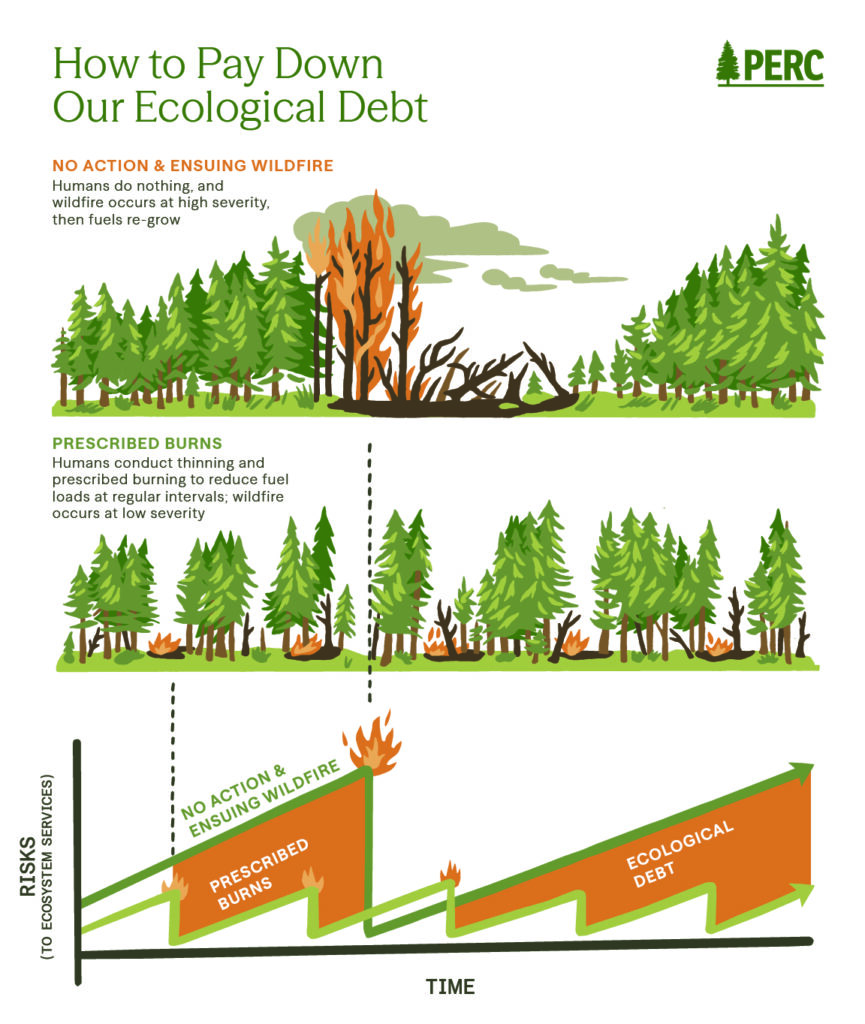
In these cases, delays caused by unwieldy human processes can have catastrophic effects, as ecosystems stray further from desired conditions. With wildfire, if planning, permitting, and carrying out fuel management projects are delayed, then we risk destruction from catastrophic mega-fires that could have been prevented. With imperiled species, procedural slowness makes recovery and ongoing management harder and more expensive. More generally, when routine ecological maintenance and management activities need to happen in perpetuity, such long-term stewardship projects should be spared from redundant and burdensome repeat permitting. Otherwise, ecological debts will continue to mount, and risks increase, as we fail to maintain ecosystem functions.
Solutions
We believe smart permitting reform can speed the pace of restoration so it overtakes the pace of degradation by replacing procedure-based policies with outcome-based ones—a formidable but feasible goal that ensures quality.
Faster human permitting processes would allow more nature-positive projects, yielding more ecological income, and would reduce ecological debt. But going faster doesn’t mean we have to sacrifice quality, or tie ourselves to static standards likely to be quickly outdated by progressing science. Instead, permit streamlining can happen safely, if certain standards for quality are met, and methodologies for assuring quality should be developed and updated externally to the government, via research-based best practices from the restoration community (e.g., academics, leading practitioners). This expert guidance could then result in a quality standard for a range of restoration projects (e.g., the standards from the Society for Ecological Restoration), which could be kept updated by non-government experts but adopted and enforced by regulators, whose primary job should be to determine whether or not the project complies with regulations. This sets the stage for implementing exclusions and exemptions with a quality check.
The Two “E’s”: Exclusions and Exemptions
When a project will clearly benefit nature, according to a quality-assurance standard as described above, it should be eligible for exclusions and exemptions—the two “E’s.” The difference between these two “E’s” is that eligible project types can be placed inherently outside the regulatory law’s scope (exclusion) or can avoid the most in-depth forms of review or requirements (exemption).
At both the federal and state levels, voluntary restoration projects should be exempted from mitigation requirements. It’s illogical and counterproductive to force projects that convert habitat from a common, degraded type into a rare, restored type to mitigate their “impacts” on the degraded habitat type; such policies delay ecological income. In fact, some restoration projects are able to self-finance by generating nature credits, based on their verified uplift. For example, organizations like Ducks Unlimited sell wetland mitigation credits from wetland restoration projects to developers looking to offset their project’s negative impacts under Clean Water Act requirements.
For example, that same Ducks Unlimited project that restored a wetland to generate wetland mitigation credits was itself subject to fill and water pollution rules, despite its positive effects on water quality over the long-term. However, there is some good news to share. The Nationwide Permit Program, administered by the U.S. Army Corps of Engineers (USACE), is reviewed every five years to ensure the permits stay up to date. Based on feedback from practitioners and policy experts, in 2026 USACE reissued nationwide permit #27 with an exemption for voluntary restoration from mitigation requirements. This is a step in the right direction and shows this line of thinking isn’t novel. We need to build on this work and continue speeding up restoration projects, setting them up for success, exempting them from “fill” rules, and not classifying sediment from this subset of projects as a water pollutant.
More broadly, many environmental laws are misaligned with restoration intentions, and their definitions are misapplied—“impact,” “disturbance,” “fill,” and “habitat conversion” confuse more than they clarify when it comes to nature-positive restoration and management projects. Federal and state law and policy should clarify these definitions and either exclude restoration from them entirely or redefine them through a positive lens.
Other exemptions and exclusions to federal regulations for restoration projects would also be helpful across core environmental laws like the National Environmental Policy Act (NEPA; how do we define impact?), the Endangered Species Act (ESA; how do we define harm?), the National Historic Preservation Act (NHPA; what do we value?), and the Clean Water Act (CWA; how do we define fill?), which all add unnecessary procedural delays and expenses to restoration projects.
State Leadership
Recently, several states have innovated to accelerate restoration permitting. One tactic is to provide exemptions and exclusions from state-level regulations. Washington’s Habitat Recovery Pilot Program streamlined much of the state’s permitting process and exempted eligible projects from the state’s analogue to NEPA. While the program expired in 2025, the state legislature is considering making it permanent as the Habitat Restoration Permit Pathway Program. As part of the Cutting Green Tape initiative, California exempted qualifying ecological restoration projects from the state’s NEPA analogue, the California Environmental Quality Act. And, to fill in regulatory gaps left by the Sackett v. EPA decision, Colorado created a state dredge and fill program that exempts and, in some scenarios, excludes qualifying voluntary stream restoration projects from regulations. Likewise, Colorado’s Beaver Conservation and Management Strategy significantly streamlines beaver relocation and restoration, which has traditionally been onerous and slow.
More states should implement and/or adopt innovative permitting solutions that streamline restoration. By implementing pilot permitting programs or including sunset clauses, states can ensure that ineffective policy tactics can be reversed or refined to incorporate lessons learned and iterate toward success.11State of California Department of Fish and Wildlife. CEQA Statutory Exemption for Restoration Projects (SERP). Accessed July 9, 2026.
Are New Laws Needed?
Thinking bigger, permitting systems should function so that scrutiny scales with the risk of negative impacts. For lower-impact projects, especially ones with reliably nature-positive effects like restoration, a system like this would yield regulatory relief, essentially a positive incentive. This is what categorical exemptions and exclusions do by removing regulatory burdens on preferred project types, but in a haphazard rather than consistent and systematic way.
To shift today’s plodding procedural processes to speedier and more substantive ones, project impacts would need to be accurately and rapidly assessed, compared to a realistic no-action scenario. Fortunately, this is now possible with improved ecological data and modern statistical approaches. But our permitting system has yet to catch up. Elegant options, like broader use of compensatory mitigation for nature, could leverage this new impact assessment ability to replace or safely streamline proceduralism. We should also consider establishing restoration targets, similar to the E.U.’s Nature Restoration Law, allowing us to increase our ecological income and pay down our ecological debt.

The Need for Speed
Projects that predictably and reliably restore ecosystems and yield nature benefits should be the simplest and fastest ones to permit. They should be the first candidates for regulatory reform that accelerates their implementation. Our current regulatory processes were designed to protect nature, but they also hamstring efforts to repair nature, making it almost impossible to reverse losses or achieve net recovery. Fixing our regulatory system so that nature repair is faster and cheaper, and projects of all kinds receive progressive regulatory relief depending on their ecosystem impacts, will improve speed and outcomes not only for the natural world, but also for people seeking to build infrastructure of all kinds. And the faster that these needed changes are made, from exclusions and exemptions for nature-positive projects to broader fixes like compensatory mitigation, the better. Every day of delay means less ecological income and more ecological debt.
This research was produced in part by researchers with the Environmental Policy Innovation Center.

Note: This report has been updated to reflect that the U.S. Army Corps of engineers already reviews and updates nationwide permits every five years, based on feedback from practitioners and policy experts, and recently expanded exemptions for voluntary mitigation projects under nationwide permit #27.