
Hoover Digest2004 No.3 Summer Cooling the Global Warming Debate: By Terry L. Anderson In the March 2004 issue of Scientific American, National Aeronautics and Space Administration global-warming expert James Hansen notes that greenhouse gas emissions and global-warming projections are “consistently pessimistic.” Hansen suggests that projections do not take into account the lower carbon dioxide andContinue reading “Why Economic Growth is Good for the Environment”
Types Archives
The Private and Public Economics of Land Trusts
North Carolina State Economist July/August 2004 By Dominic P. Parker and Walter N. Thurman As people become increasingly concerned about the effects of urbanization on their quality of life, the land conservation movement has moved to center stage. Land trusts are key actors in the movement and their influence is rapidly expanding. Almost 1,300 landContinue reading “The Private and Public Economics of Land Trusts”
The Wealth of Indian Nations
Hoover Digest 2004 No.3 Summer It is said that a rising tide raises all boats, but that has not been true for American Indians. Despite recent growth partly due to gambling, per capita income for Native Americans living on reservations in 1999 was $7,846 compared to a U.S. average of $27,880. This puts reservation IndiansContinue reading “The Wealth of Indian Nations”
Water trades work elsewhere:
Herald and NewsKlamath Falls, ORJune 14, 2004 Water trades work elsewhere:Why not in the Basin? By Jane S. Shaw We used to hear the expression “Let George do it” to describe the very human tendency to leave the solution of a problem to someone else. Today, we tend to let the federal government be “George.”Continue reading “Water trades work elsewhere:”
Solutions for the Klamath Basin
Conference Organized by PERC Klamath Falls, Oregon June 8, 2004 Summary The Klamath Basin conflict between endangered fish and farmers stems from a failure to establish who actually owns the water. The establishment and clarification of ownership rights may help resolve matters. The Property and Environment Research Center hosted a June 8 conference in KlamathContinue reading “Solutions for the Klamath Basin”
2004 Index of Leading Environmental Indicators, Ninth Edition
From the Pacific Research Institute and the American Enterprise Institute Full Text PDF PUBLIC LAND MANAGEMENT By Holly Lippke Fretwell Four federal land management agencies oversee an estate of 614 million acres, an area more than six times the size of California with an estimated value exceeding $150 billion. Despite this wealth of resources, thereContinue reading “2004 Index of Leading Environmental Indicators, Ninth Edition”
Accounting for Species:

By Randy T. Simmons and Kimberly Frost Executive Summary About the Authors Introduction [[{“type”:”media”,”view_mode”:”media_original”,”fid”:”7202″,”attributes”:{“alt”:””,”title”:””,”class”:”media-image”,”typeof”:”foaf:Image”,”style”:”width:180px;height:119px;float:left;margin:0 1em 1em 0;”,”wysiwyg”:1}}]] Without accurate figures for the costs of the Endangered Species Act, the ongoing public debate over whether the law is effective will be a misinformed one. This study, Accounting for Species, contributes to the debate by analyzing theContinue reading “Accounting for Species:”
Accounting for Species:
Executive Summary By Randy T. Simmons and Kimberly Frost Arational public dialogue about the value and effectiveness of the Endan- gered Species Act (ESA) must consider the costs incurred by the regulators and those being regulated. The U.S. Fish and Wildlife Service�??s report Three-Year Summary of Federal and State Endangered Species Expenditures, Fiscal Years 1998-2000Continue reading “Accounting for Species:”
Anthony Fisher Award Presented to Eco-nomics
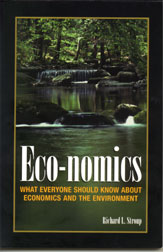
Eco-nomics What Everyone Should Know About Economics and the Environment Order the Book CHICAGO – April 28, 2004-The Atlas Economic Research Foundation presented its 2004 Sir Antony Fisher International Memorial Award to PERC, the Property and Environment Research Center, of Bozeman, Montana, today. The award was given for the book Eco-Nomics: What Everyone ShouldContinue reading “Anthony Fisher Award Presented to Eco-nomics”
Economic Report of the President – 2004
Chapter 9: Protecting the Environment Economic growth and environmental improvements go hand-in-hand. Economic growth can lead to increased demand for environmental improvements and can provide the resources that make it possible to address environmental problems. Some policies aimed at promoting environmental improvements can entail substantial economic costs. Misguided policies might actually achieve less environmental progressContinue reading “Economic Report of the President – 2004”