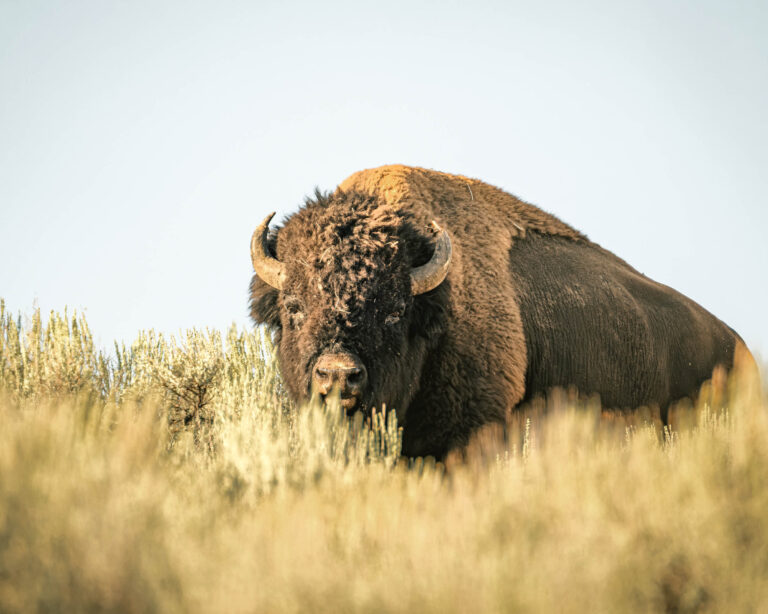
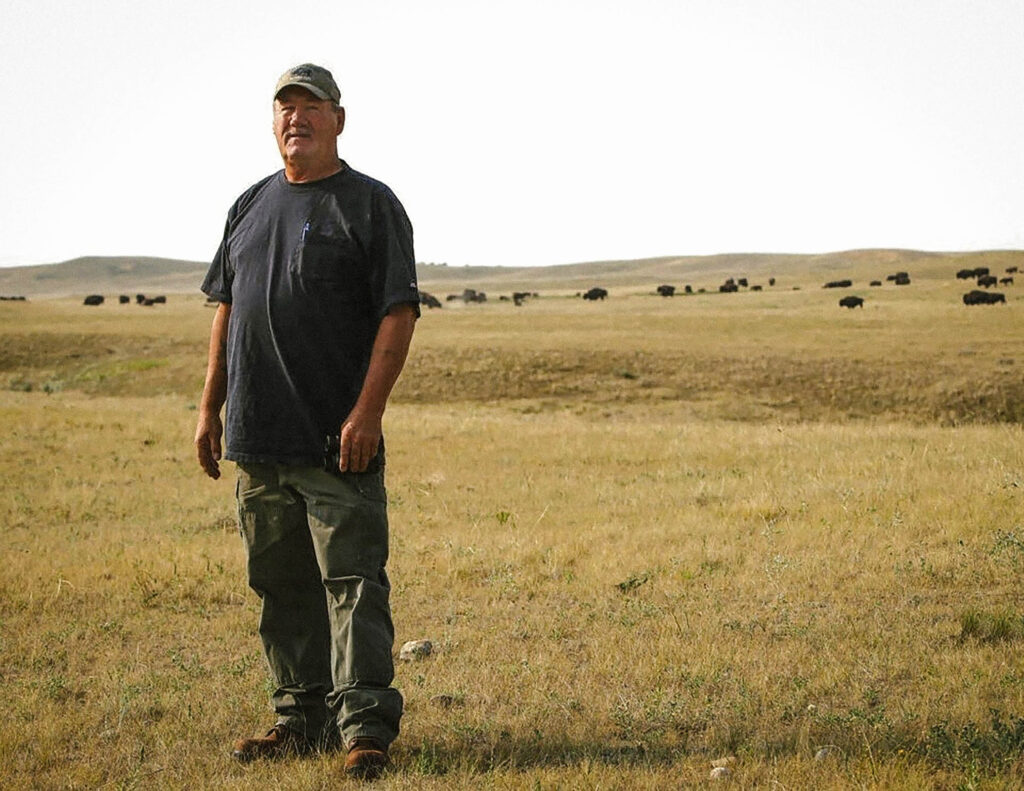
“I’ve been working with bison for over 27 years,” says Robert Magnan, the Fort Peck Reservation’s buffalo program manager, “and I’m still learning from them. They’re still teaching me.” The Fort Peck program, now home to one of the largest tribal herds in the country, manages more than 800 bison on 33,000 acres of grassland on the reservation. Magnan has overseen the herd’s management and operations for nearly 15 years. For him, bringing the buffalo back to Fort Peck has been a blessing, though it has come with its share of trial, error, and lessons learned.
Since the 1800s, the buffalo and Native American tribes have followed similar arcs—removed from their lands, confined, and nearly erased. Today, the Assiniboine and Sioux tribes of the Fort Peck Reservation are reclaiming both the buffalo and the aspects of their cultures that nearly disappeared alongside them. In 1987, Fort Peck tribal elders decided it was time to restore vital cultural practices by bringing the buffalo back home. Two years later, the tribes purchased over 100 bison from the Fort Belknap Reservation, about 100 miles west of Fort Peck, and set aside 5,800 acres of land to start a cultural herd and program in northeastern Montana.
Early on, the costs of managing the herd pushed the Assiniboine and Sioux tribes—two distinct tribal nations who share the Fort Peck Reservation—toward a revenue-generating solution: bison hunting. Hunters came regularly, and proceeds followed for the tribes—but so did a reckoning. “Our elders came back and said we lost the purpose of why we brought the bison back,” says Magnan. “The hunts stopped, and the focus returned to culture.”
But as Fort Peck focused on its cultural program, a separate conflict was unfolding that would eventually bring legal battles to the reservation. In Yellowstone National Park, wildlife managers stopped aggressively limiting the bison population in the mid-20th century, and its numbers subsequently grew into the thousands. In 2000, in response to concerns about potential disease risk to livestock, the federal government and Montana state agencies developed the Interagency Bison Management Plan. Since the plan took effect, there has been no documented brucellosis transmission from bison to cattle. Federal, state, and tribal partners eventually began working to transfer bison to tribal lands across North America, including Fort Peck. The InterTribal Buffalo Council, a collection of more than 80 tribes dedicated to creating and maintaining sustainable bison programs, later officially joined the plan as a member.
In the spring of 2012, Montana Fish, Wildlife, and Parks transferred 61 certified disease-free Yellowstone bison to Fort Peck, with an agreement to send half to the Fort Belknap Reservation once its pastures were ready. The tribes of Fort Peck and Fort Belknap agreed to the split, “but that’s when the legal fight started,” says Magnan. Critics filed suit, arguing that the bison transfer violated a Montana law that requires landowner approval and a management plan for any bison transfer. In 2013, the case reached the Montana Supreme Court, which ruled unanimously that the law had been misapplied—tribal lands are neither public nor private property, meaning tribes are beyond the statute’s reach. Once the legal battles were settled, Fort Peck formally separated its herd into two: a business herd used to generate revenue to cover the costs of bison management, and a cultural herd, made up of the Yellowstone-sourced bison, for tribal hunting lotteries and food distribution.
With the cultural herd established and the legal disputes in the past, Fort Peck turned its attention to expanding the buffalo program’s reach. In 2017, the reservation built its own quarantine facilities to help Yellowstone National Park certify bison as brucellosis-free. This partnership evolved into the Buffalo Conservation Transfer Program, through which bison complete a two-phase quarantine process. “Bison spend two years in Yellowstone and one year at Fort Peck,” says Magnan. “We’ve been running it for nine years, and to date we have distributed brucellosis-free buffalo to 27 reservations across 16 states, including Alaska. Last year we made our first international bison transfer to Canada.”
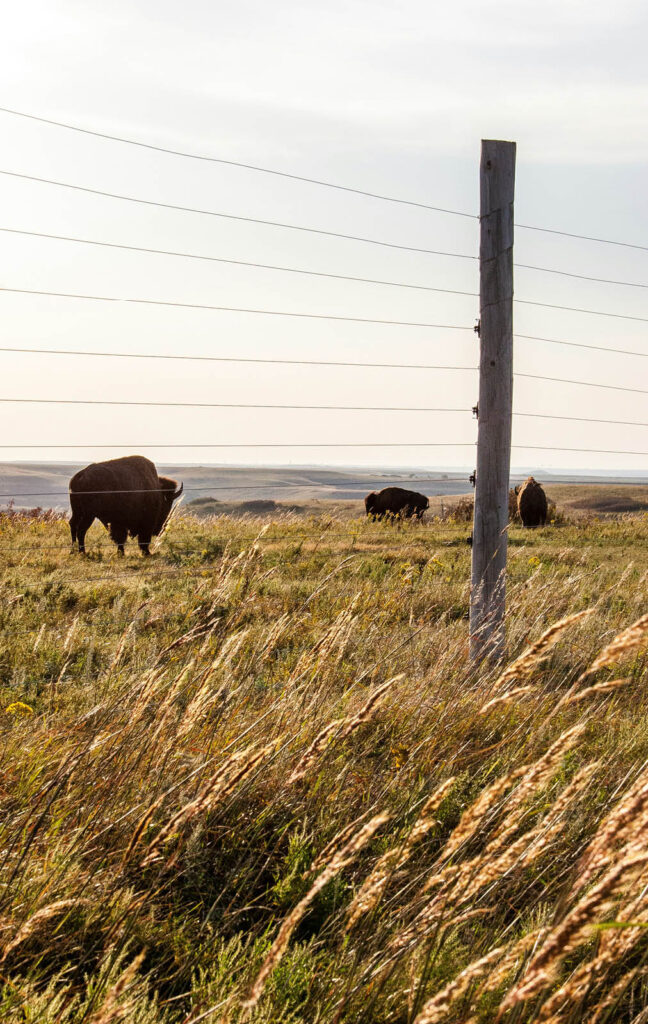
The return of the buffalo to Fort Peck and the herd’s subsequent expansion have meant more than numbers and legal victories; they have meant the return of a crucial aspect of the tribes’ cultures. “Cultural practices that had faded are coming back,” Magnan says. “Our people used to follow the buffalo and model their way of life on theirs. If we could return to that, we’d be more resilient as a people.” To help restore those practices, the tribes started a hunting lottery that benefits tribal members who draw tags and improves the health of bison pastures by managing herd numbers. Demand for the lottery has only grown among members of the Assiniboine and Sioux tribes. “Last year we issued 50 tags so tribal members could harvest one bison themselves,” says Magnan. “People argue when they don’t get picked, which tells you how much demand there is. That’s a good feeling.”
Alongside the cultural importance, returning bison to Fort Peck has presented a meaningful opportunity for the Assiniboine and Sioux tribes to use the buffalo again as a food source. During the Covid pandemic, as well as a later federal government shutdown, the reservation’s bison program was able to process some of its animals to feed over 70 people. “The buffalo are providing for us again,” adds Magnan. “It has become one of our most important tools for food sovereignty.”
“The buffalo are providing for us again. It has become one of our most important tools for food sovereignty.”
— Robert Magnan
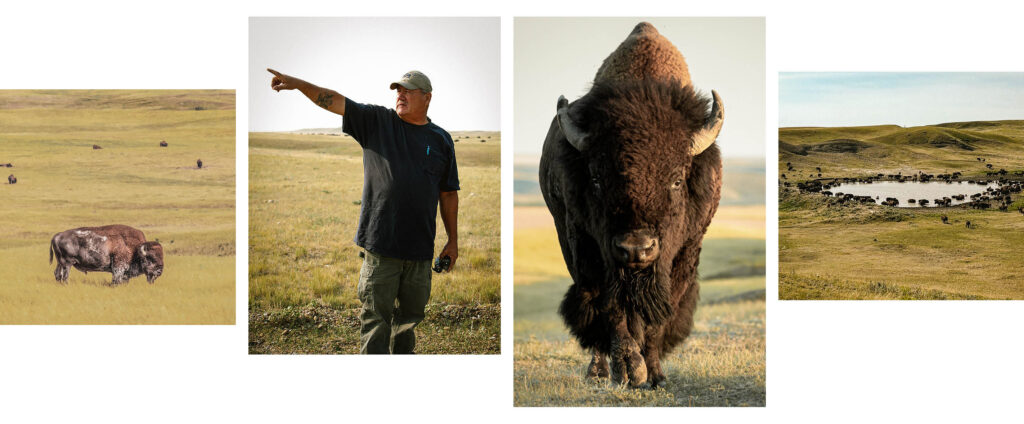
As the Fort Peck bison continue to flourish and grow, the path forward will require careful land management and close monitoring of environmental review processes in the state of Montana. According to Magnan, Fort Peck aims to grow its herd to 1,500 bison roaming 150,000 acres of pasture, which would be enough to provide a sustainable food source for the community while keeping the land healthy. “We have to stay within our carrying capacity,” he adds. “People sometimes ask why we cull bison from the herd, as if it contradicts our values. But taking animals is what keeps the land and the herd in balance. The buffalo take care of us, and we have to take care of the land that takes care of them.”
Management of the herd and transfers of animals from it are now under pressure from outside the Fort Peck Reservation. An ongoing Montana lawsuit challenging Yellowstone’s bison management plan leaves future transfers in the state uncertain. The complaint argues that the National Park Service failed to consult with the state of Montana. If successful, the suit could shrink the pool of Yellowstone bison available for tribal transfer. “If that happens, our transfer program dies,” says Magnan. “All the work we’ve done would come to a halt.”
Yet what Fort Peck has already built stands as a model for what tribal stewardship can accomplish. Tribal sovereignty gives the Assiniboine and Sioux strengths that many federal and private conservation actors don’t have: cultural reverence, traditional ecological knowledge, and relationships with members of other tribes. Unlike federal agencies or private conservation groups, Fort Peck answers to its own people—not bureaucratic processes or outside approval. “We don’t have to go through the same red tape,” says Magnan. “People told us we’d need state and federal approval to process and distribute our own meat. We said no—we’re not reselling it, we’re giving it to our people.” That autonomy, however, has its limits. Land acquisition remains a persistent obstacle. Neighboring landowners who are willing to sell their property often price it beyond what the tribes can offer, leaving potential pasture expansion for Fort Peck out of reach.
Still, Magnan remains clear-eyed about what Fort Peck is trying to build, and why it matters beyond the reservation. “What happened to our people and what happened to the buffalo followed the same pattern,” he says. “Now we have a chance to help restore and sustain the buffalo like the way they once sustained us. All we’re asking is to be allowed to do that.”