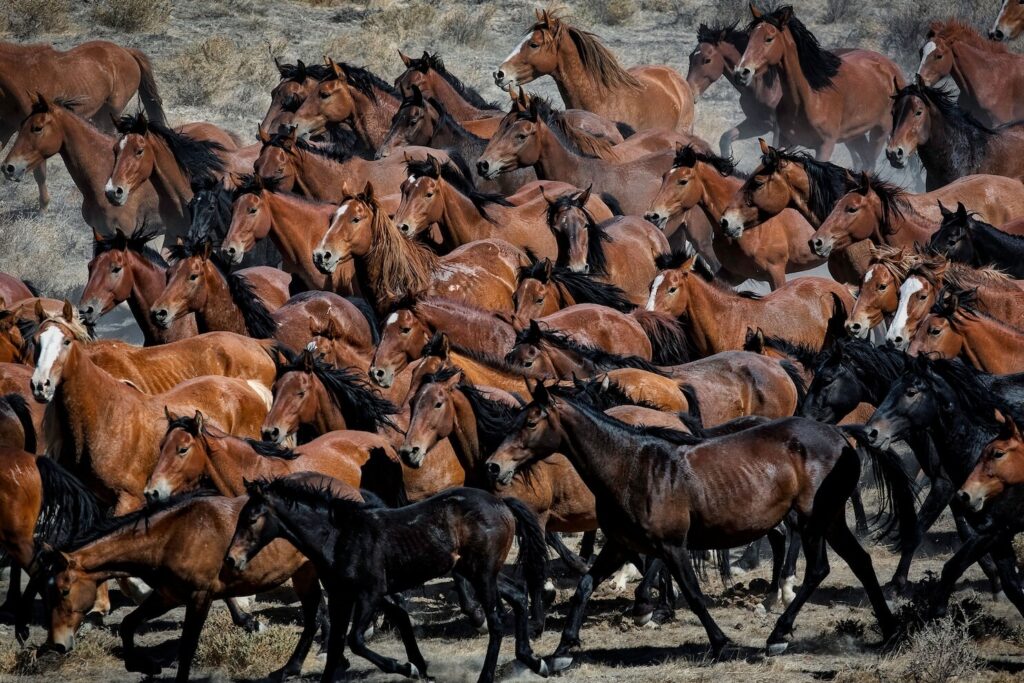
Across the West, wild horse and burro populations have grown far beyond what the landscape can support. The result is degraded vegetation and soils, trampled wetlands and riparian areas, depleted forage and water for native wildlife and livestock, and animals suffering from starvation and thirst.
That is why PERC joined the American Farm Bureau Federation, Association of Fish & Wildlife Agencies, Mule Deer Foundation, National Cattlemen’s Beef Association, Public Lands Council, Rocky Mountain Elk Foundation, and Wild Sheep Foundation in submitting comments to the Bureau of Land Management (BLM) on its planned Programmatic Environmental Assessment for wild horse and burro management.
The scale of the problem demands more than the status quo. BLM estimates that roughly 85,000 wild horses and burros live across 175 herd management areas in 10 Western states—more than three times the appropriate management level. Because these populations grow 15 to 25 percent each year, delays make the problem much worse.
The current system also leaves taxpayers paying more to manage failure than to restore balance. More than 62,000 animals are in holding facilities, costing over $100 million per year and consuming roughly 70 percent of the program’s budget. Those dollars should support better outcomes for horses, burros, wildlife, and rangelands, not indefinitely holding and feeding animals that can’t be adopted or sold.
Incentives are central to solving the problem. PERC’s research has shown that adoption incentives can help place animals in private homes and on ranches while saving taxpayers hundreds of millions of dollars over time. BLM should restore and improve those tools, while also analyzing cooperative management with states, tribes, and local governments; gathers and removals to appropriate management levels; longer-lasting and more effective fertility control; and the use of the full range of options Congress has provided.
Wild horse and burro management is a conservation issue. Healthy herds require healthy rangelands, healthy rangelands support native wildlife and livestock, and maintaining that balance requires practical tools and incentives that work. BLM’s programmatic review is an opportunity to move past the current cycle of overpopulation, ecological damage, and rising costs and toward a system that better serves horses, wildlife, public lands, and taxpayers.