
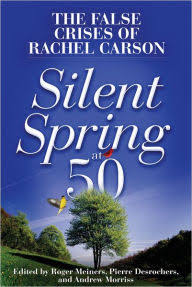
 Widely credited with launching the modern environmental movement when published 50 years ago, Rachel Carson’s Silent Spring had a profound impact on our society. As an iconic work, the book has often been shielded from critical inquiry, but this landmark anniversary provides an excellent opportunity to reassess its legacy and influence. In Silent Spring at 50: The False Crises of Rachel Carson a team of national experts explores the book’s historical context, the science it was built on, and the policy consequences of its core ideas. The conclusion makes it abundantly clear that the legacy of Silent Spring is highly problematic. While the book provided some clear benefits, a number of Carson’s major arguments rested on what can only be described as deliberate ignorance. Despite her reputation as a careful writer widely praised for building her arguments on science and facts, Carson’s best-seller contained significant errors and sins of omission. Much of what was presented as certainty then was slanted, and today we know much of it is simply wrong.
Reviews
A powerful collection that offers new insights on Carson’s epoch-making book and challenges its scientific underpinnings and purpose. This book should stir even the most committed Carson enthusiast to reassess Silent Spring’s much celebrated status. A must read for those who take the environment seriously.
— Bruce Yandle
Dean Emeritus, College of Business and Behavioral Science, Clemson University
This book offers a much needed perspective on one of the most misguided and overpraised books of the 20th century. However noble her intentions, in Silent Spring, Rachel Carson provided the impetus for a half-century of environmental policies that have cost hundreds of millions of lives and elicited antagonism toward many products and technologies that could have benefited the planet and its inhabitants.
— Henry Miller
Robert Wesson Fellow in Scientific Philosophy and Public Policy, Hoover Institution, Stanford University
Silent Spring sent environmental policy down the road of more and more federal regulation. The authors in this book review Rachel Carson’s data and conclusions and find that both are flawed. By reading this book and giving it to your favorite politician and environmentalist friends, you will help create a better environment and enhance individual freedom.
— Terry Anderson
President, Property and Environment Research Center, and Senior Fellow, Hoover Institution
Rather than paying tribute to Rachel Carson’s manifesto Silent Spring at 50 pays her work the compliment of expecting and demanding that it stand up to empirical and theoretical doubts. My respect for Carson’s legacy has now been informed, tested, and refined by authors who treated Carson as the scientist she sought to be.
— Heidi M. Hurd
Director of the Program in Law and Philosophy, University of Illinois.
Silent Spring at 50 brings together a brilliant collection of scholars to evaluate this founding text of modern environmentalism. Five decades after its publication they show that Rachel Carson got a lot of her science wrong and that her passionate advocacy may have resulted in more harm than good.
— Ron Bailey
Science Correspondent, Reason